
THE CINEMASTERY JOURNAL
What is a Tracking Shot: The Complete Filmmaker’s Guide
15 July 2026 · 10 min read
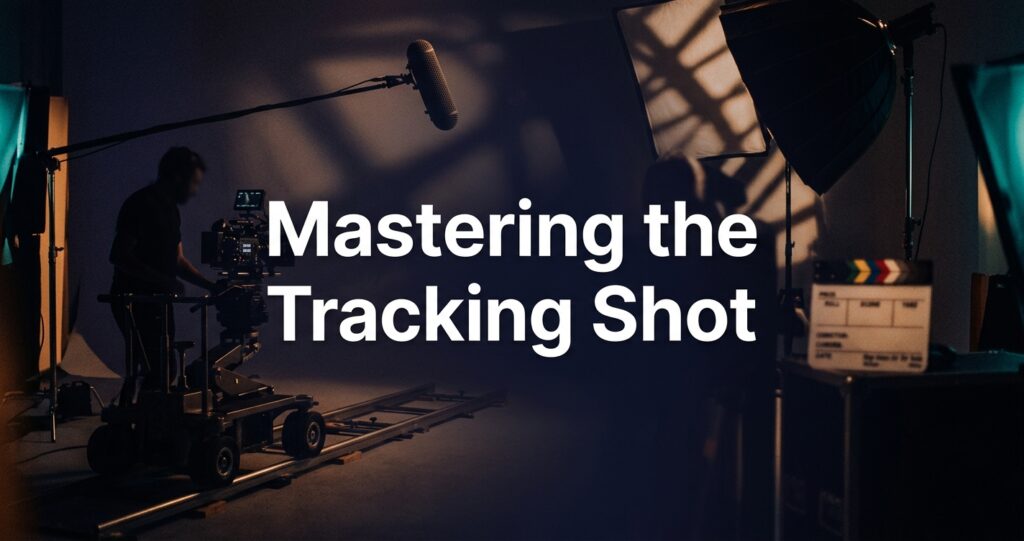
If you have ever wondered what is a tracking shot, you are looking at one of the most powerful tools in a filmmaker’s kit, and in 2026 dynamic camera movement like tracking was identified as the top creative strategy for holding the attention of audiences with historically short attention spans. In this complete filmmaker’s guide, we break down the definition, the types, the emotional effect of each direction, the gear, and the famous examples that turned tracking shots into cinematic legend.
Table of Contents
- What Is a Tracking Shot? The Definition
- Key Takeaways
- Types of Tracking Shots: Follow, Push-In, Pull-Out, Lateral
- The Emotional Effect of Each Direction
- Technical Execution: Dolly Track, Gimbal, and Handheld
- Famous Tracking Shot Examples: Goodfellas, Children of Men, and Kubrick
- When to Use a Tracking Shot vs. When to Avoid It
- Conclusion
- Frequently Asked Questions
What Is a Tracking Shot? The Definition
A tracking shot is any shot where the camera physically moves through space to follow, approach, retreat from, or travel alongside a subject. The whole camera body changes position, which separates it from a pan or a tilt where the camera only pivots on a fixed point.
As filmmakers, we use tracking shots to make the audience feel like a participant rather than an observer. The movement pulls the viewer into the geography of the scene and ties them to the characters moving through it.
The term comes from the literal “track” that a dolly once rode on, but the principle now covers gimbals, Steadicams, and handheld rigs. If the camera travels, you are tracking.
Key Takeaways
| Question | Quick Answer |
|---|---|
| What is a tracking shot? | A shot where the whole camera moves through space to follow or travel with a subject. |
| What are the main types? | Follow, push-in, pull-out, and lateral tracking shots. |
| What gear do you need? | A dolly and track, a gimbal, or a handheld rig depending on the feel you want. |
| Why use one? | It increases viewer involvement and serves visual storytelling without dialogue. |
| Most famous example? | The Copacabana entrance in Goodfellas and the car ambush in Children of Men. |
| When should you avoid it? | When the movement distracts from a quiet performance or has no narrative reason. |
Types of Tracking Shots: Follow, Push-In, Pull-Out, Lateral
Once you understand what a tracking shot is, the next step in this filmmaker’s guide is learning the four core variations. Each one moves the camera differently and signals a different idea to the audience.
The Follow Shot
The follow shot trails or leads a character as they walk, run, or drive. We use it to bind the viewer to a person’s journey, creating a sense of shared momentum.
Following from behind builds curiosity about where the character is headed. Leading from the front lets us read their face while the world streams past them.
The Push-In
A push-in drives the camera slowly toward the subject. It tightens the frame and concentrates our attention, often used at the exact moment a character has a realization.
The push-in is one of the most emotionally loaded moves we have. Done slowly, it feels like we are leaning in to listen.
The Pull-Out
The pull-out (or pull-back) retreats from the subject, gradually revealing the surrounding environment. We use it to isolate a character, show abandonment, or end a scene on a note of scale.
It is the visual equivalent of stepping away. The subject shrinks, and the world grows around them.
The Lateral Track
A lateral or “crab” track moves the camera sideways, parallel to the action. It is ideal for walk-and-talk scenes and for revealing a line of subjects one by one.
The lateral track keeps the subject in a stable frame while the background slides by. This contrast between a steady subject and moving scenery creates a smooth, observational rhythm.
The Emotional Effect of Each Direction
The direction of a tracking shot is not neutral. Every move carries a feeling, and as filmmakers we choose direction to match the emotion of the scene.
- Push-in: Intimacy, tension, realization, and growing focus. The audience feels pulled closer to a truth.
- Pull-out: Isolation, loss, scale, and conclusion. The character is released into a larger, sometimes lonelier world.
- Forward follow: Drive, purpose, and forward momentum. We share the character’s determination.
- Reverse follow (leading): Anticipation and dread. We see the character but not what waits ahead of them.
- Lateral: Observation, comparison, and steady passage of time. The viewer becomes a calm witness.
Matching direction to emotion is what separates a decorative camera move from a meaningful one. The move should answer a question the scene is asking.
Technical Execution: Dolly Track, Gimbal, and Handheld
Knowing what a tracking shot is matters little without knowing how to execute one cleanly. In this section of the filmmaker’s guide, we compare the three main delivery systems.
Dolly and Track
The dolly is a wheeled platform that rides on laid track or smooth flooring. It produces the most controlled, repeatable, and elegant movement available.
We reach for a dolly when we want precision, especially for a slow push-in where any wobble would break the spell. The trade-off is setup time, since laying track takes crew and planning.
Gimbal
A motorized gimbal stabilizes a camera electronically while the operator walks. It gives us the freedom to move through doorways, up stairs, and around obstacles that no track could cross.
Gimbals are the modern workhorse for fluid, “floating” tracking shots. For more advanced repeatable paths, some teams turn to robotic motion control systems that combine the smoothness of a dolly with curved freedom.
Handheld
Handheld tracking trades polish for energy. The natural shake puts us inside the chaos, which is why it dominates documentary, war, and thriller sequences.
We choose handheld when raw immediacy serves the story more than smoothness does. It is the most accessible method and requires no extra hardware.
| Method | Feel | Best For |
|---|---|---|
| Dolly & Track | Smooth, precise, classical | Slow push-ins, formal reveals |
| Gimbal | Floating, fluid, free | Long走-throughs, complex paths |
| Handheld | Raw, urgent, kinetic | Action, documentary, tension |
An at-a-glance guide to tracking shots. Learn the definition, the different types, the emotions they evoke, the gear you need, and practical use cases.
Famous Tracking Shot Examples: Goodfellas, Children of Men, and Kubrick
No filmmaker’s guide to tracking shots is complete without the sequences that defined the form. These examples are studied in every film school for good reason.
Goodfellas (1990)
Martin Scorsese’s Copacabana sequence follows Henry and Karen in a single unbroken Steadicam tracking shot through a kitchen and into the club. The continuous movement makes us feel the seductive privilege of the gangster lifestyle in real time.
It works because the move is motivated. We experience the world the way Karen does, swept along and dazzled.
Children of Men (2006)
Alfonso Cuarón’s film features tracking shots so long and complex they redefined what audiences thought possible. The car ambush and the final battle sequence place us directly inside the danger with no edit to relieve the tension.
The relentless single-take tracking forces us to share every second of fear with the characters. There is no cut to escape to.
Stanley Kubrick
Kubrick built a career on the dolly and the Steadicam. The corridor tracking shots in The Shining, following Danny’s tricycle, are a masterclass in dread created purely through smooth, relentless forward motion.
Kubrick proved that a tracking shot does not need action to be terrifying. The calm, gliding movement itself becomes unsettling.
When to Use a Tracking Shot vs. When to Avoid It
A tracking shot is a statement, not a default. Understanding when to use one is as important as knowing what a tracking shot is in the first place.
When to Use a Tracking Shot
- To follow a character through space and build momentum.
- To reveal information gradually, such as pulling out to show a hidden detail.
- To intensify a moment with a slow push-in during a realization.
- To immerse the audience in chaos or action with a handheld follow.
- To establish geography and connect locations in a single continuous take.
When to Avoid a Tracking Shot
- When a static frame would let a quiet performance breathe.
- When the movement has no narrative reason and only shows off gear.
- When your schedule cannot support the rehearsal time a complex move demands.
- When the location is too tight or unstable for safe, smooth execution.
The best filmmakers treat every move as a choice that serves the story. If a cut or a locked frame says it better, we use that instead. Pairing camera movement with strong cinematography and lighting is what makes a tracking shot land.
Conclusion
Now you have a complete answer to what is a tracking shot, from the core definition to the four types, the emotional weight of each direction, the gear, and the legendary examples that shaped the craft. A tracking shot is never just movement for its own sake, it is a decision that ties the audience to your story.
As you build your own work, treat this filmmaker’s guide to the tracking shot as a starting point and study how directors like Scorsese, Cuarón, and Kubrick motivated every move. To go further, explore our companion lessons on framing relationships in the 2 shot and the mid shot in storytelling.
Frequently Asked Questions
What is a tracking shot in simple terms?
A tracking shot is a shot where the entire camera moves through space to follow or travel with a subject, instead of just pivoting in place. It differs from a pan or tilt because the camera body actually changes position.
What is the difference between a tracking shot and a dolly shot?
A dolly shot is a type of tracking shot executed specifically on a wheeled dolly riding a track. All dolly shots are tracking shots, but tracking shots can also be achieved with a gimbal, Steadicam, or handheld rig.
Is a tracking shot still worth using in 2026?
Yes, the tracking shot remains highly relevant, and in 2026 dynamic camera movement is one of the top strategies for holding audience attention. It increases viewer involvement and works across both cinema and short-form content.
What gear do I need for a smooth tracking shot?
For the smoothest result, a dolly and track give controlled, repeatable movement, while a gimbal offers fluid freedom to move through tight spaces. Handheld works when you want raw energy and have no extra equipment.
What is the most famous tracking shot of all time?
The Copacabana sequence in Goodfellas and the single-take ambush in Children of Men are widely considered the most famous tracking shots. Kubrick’s corridor moves in The Shining are also studied as defining examples.
When should I avoid using a tracking shot?
Avoid a tracking shot when a static frame would better serve a quiet, intimate performance, or when the movement has no narrative purpose. Forced camera movement that only shows off gear distracts the audience from the story.
How long can a tracking shot be?
A tracking shot can run as long as the technology and choreography allow, with Hitchcock’s Rope using takes of 8 to 10 minutes to create a seamless effect. Modern gimbals and digital cameras make extremely long continuous tracking shots more achievable than ever.