Are your shots falling flat? Does your visual storytelling feel random, a collection of images that lack a true, visceral heartbeat? In an age where so much filmmaking looks the same, your choice of frame is an act of rebellion, a declaration of intent. The secret to forging a real connection with your audience often lies not in the epic establishing shot or the dramatic close-up, but in the powerful, intimate space between them. This is the domain of the mid shot film, the unsung hero of cinematic language and the key to unlocking character and emotion with an artist’s precision.
Forget sterile, academic rules. This is your guide to wielding the most versatile shot in cinema with purpose and power. We will dissect how this crucial framing builds intimacy, reveals the subtle truths of your characters, and drives your narrative forward with undeniable momentum. By the end, you will move beyond guesswork, learning to choose your shots with the confidence of an auteur and transforming your filmmaking from a craft into an art form that leaves a lasting, emotional impact.
Key Takeaways
- Understand the mid shot not as a technical definition, but as the cinematic language of human connection, mirroring how we perceive the world in intimate conversation.
- Go beyond imitation by deconstructing how master directors wield the mid shot film to reveal a character’s inner world and drive the narrative with devastating emotional impact.
- Master the subtle variations of the mid shot, learning to manipulate the frame to fine-tune your audience’s emotional relationship with your characters and their environment.
- Transform the mid shot from a default choice into a deliberate, powerful act of storytelling by orchestrating it with lighting, composition, and performance.
Table of Contents
- What is the Mid Shot? The Canvas of Character and Context
- Deconstructing the Masters: Iconic Mid Shots in Film History
- The Mid Shot Family: Expanding Your Visual Language
- The Director’s Choice: When to Wield the Mid Shot
- Elevate Your Craft: Forging a Cinematic Mid Shot
What is the Mid Shot? The Canvas of Character and Context
Forget the dry, textbook definitions. In the grand symphony of cinematography, the mid shot is not merely a technical choice; it is the perfect equilibrium. It is the great mediator-the essential bridge between the epic, detached scale of a wide shot and the raw, visceral intensity of a close-up. This is the shot that mirrors our own human perception, framing a character the way we would see them in a meaningful conversation. It’s the workhorse of cinema, the unsung hero that grounds your audience in the scene, making them a participant rather than a passive observer.
Defining the Frame: A Balance of Information
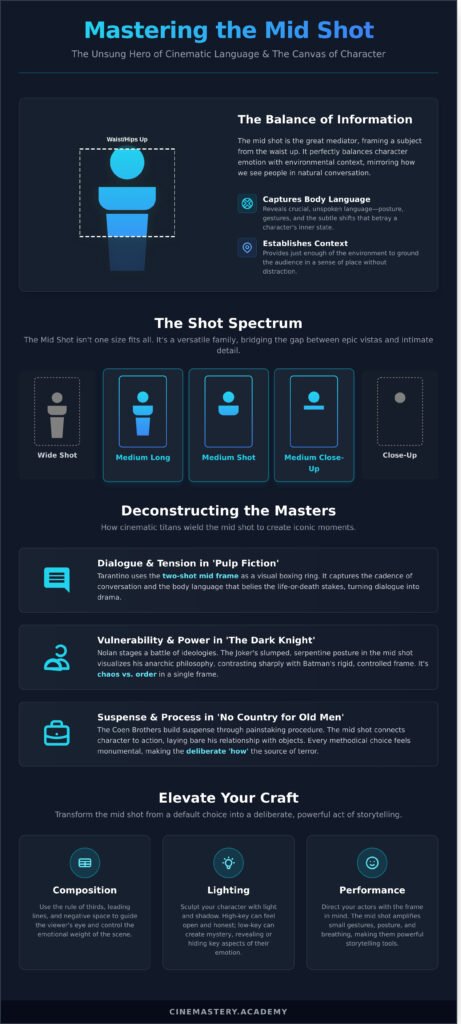
At its core, the classic Medium shot frames your subject from the waist or hips to just above their head. But to see it so simply is to miss its power. This frame is a canvas that reveals both character and context in beautiful harmony. It captures the crucial, unspoken language of the body-the subtle clenching of a fist, the nervous rhythm of breathing, the posture that betrays a character’s confidence or fear. It gives us just enough of the surrounding environment to establish a sense of place without overwhelming the focus on the human element at the story’s heart.
The Psychology of Proximity: Why the Mid Shot Feels ‘Right’
Why does this particular framing feel so natural, so right? Because it respects the invisible boundaries of personal space. This is the distance of trust, of genuine interaction. A well-executed mid shot film technique doesn’t just show you a character; it invites you into their world. It fosters a unique intimacy, allowing the audience to observe the nuances of a performance without the confrontation of a close-up. You are close enough to connect, to build an empathetic bond, but with enough space to interpret the full spectrum of their emotional and physical state. It transforms seeing into feeling.
Deconstructing the Masters: Iconic Mid Shots in Film History
A shot is never just a shot. In the hands of a master, it is a scalpel, used to carve away the mundane and reveal the soul of the story. The mid shot film technique, often dismissed as merely functional, becomes a canvas for profound character work and simmering tension. The greatest directors understand that this is where the human element-the gesture, the posture, the subtle shift in weight-transforms dialogue into drama. Let’s dissect how cinematic titans manipulate this fundamental tool to create unforgettable moments.
Dialogue and Tension in ‘Pulp Fiction’
Quentin Tarantino orchestrates dialogue like a symphony of violence and wit. In the iconic diner scene, he locks Vincent and Jules in a two-shot mid frame. This isn’t just for coverage; it’s a visual boxing ring. The mid shot captures the rhythmic cadence of their conversation, but more importantly, their body language. We see every lean, every pointed finger, every casual sip of coffee that belies the life-or-death stakes. Their words are the melody; their bodies are the percussion.
Vulnerability and Power in ‘The Dark Knight’
Christopher Nolan uses the mid shot to stage a battle of ideologies. During the interrogation, the Joker is framed from the waist up, his slumped, almost serpentine posture a stark visual of his anarchic philosophy. His wild gestures are contained but not tamed by the frame. While there are many variations of this shot, as detailed in MasterClass’s guide on What Is a Medium Shot?, Nolan’s choice here emphasizes chaos. In contrast, Batman’s mid shots are rigid, his body a controlled weapon.
Quiet Desperation in ‘No Country for Old Men’
The Coen Brothers are masters of suspense built on process. When we watch Llewelyn Moss, the mid shot is used not for explosive action, but for painstaking procedure. We see him tending his wounds or hiding the money, his relationship with the objects around him laid bare. The frame connects character to action, making every methodical choice feel monumental. The suspense isn’t in what will happen, but in the terrifying, deliberate how, a desperation felt in every frame.
The Mid Shot Family: Expanding Your Visual Language
The mid shot is not a single, rigid frame. It is a living, breathing family of shots, a spectrum of emotional tools at your command. To master the mid shot film technique is to understand its subtle variations not as technical terms from a textbook, but as a painter understands their palette. Each variation offers a profoundly different relationship with your character and their world, allowing you to control the precise level of intimacy and context. This is where you graduate from technician to artist, manipulating space to sculpt the audience’s soul.
The Medium Close-Up: The Soulful Confession
Framed from the chest up, this is your tool for dialing up emotional intensity. The Medium Close-Up is a whisper in a crowded room. It captures the visceral truth in a character’s micro-expressions-the flicker of doubt in their eyes, the subtle clench of their jaw-while retaining the language of their posture. Use it when a character’s internal feeling begins to overpower the scene, demanding to be seen and felt.
The Medium Long Shot (Plan Américain): The Character in the World
While the standard Oxford Reference definition of a mid-shot frames a character from the waist up, the Medium Long Shot (or Plan Américain) pulls back to the knees. This deliberate choice places your character firmly within their environment. It’s perfect for revealing purposeful movement, body language, and a character’s relationship to their surroundings, creating a broader emotional canvas for their story to unfold upon.
The Cowboy Shot: The Stance of Power
Born from the dusty standoffs of classic Westerns, the Cowboy Shot frames from mid-thigh up. Its purpose is primal: to reveal a weapon, a gesture, or a confident stance. In modern filmmaking, it has evolved into a pure expression of power and intent. This is the shot of readiness, of potential action simmering just below the surface, promising that chaos or control is about to be unleashed.
The Two Shot: The Dance of Relationship
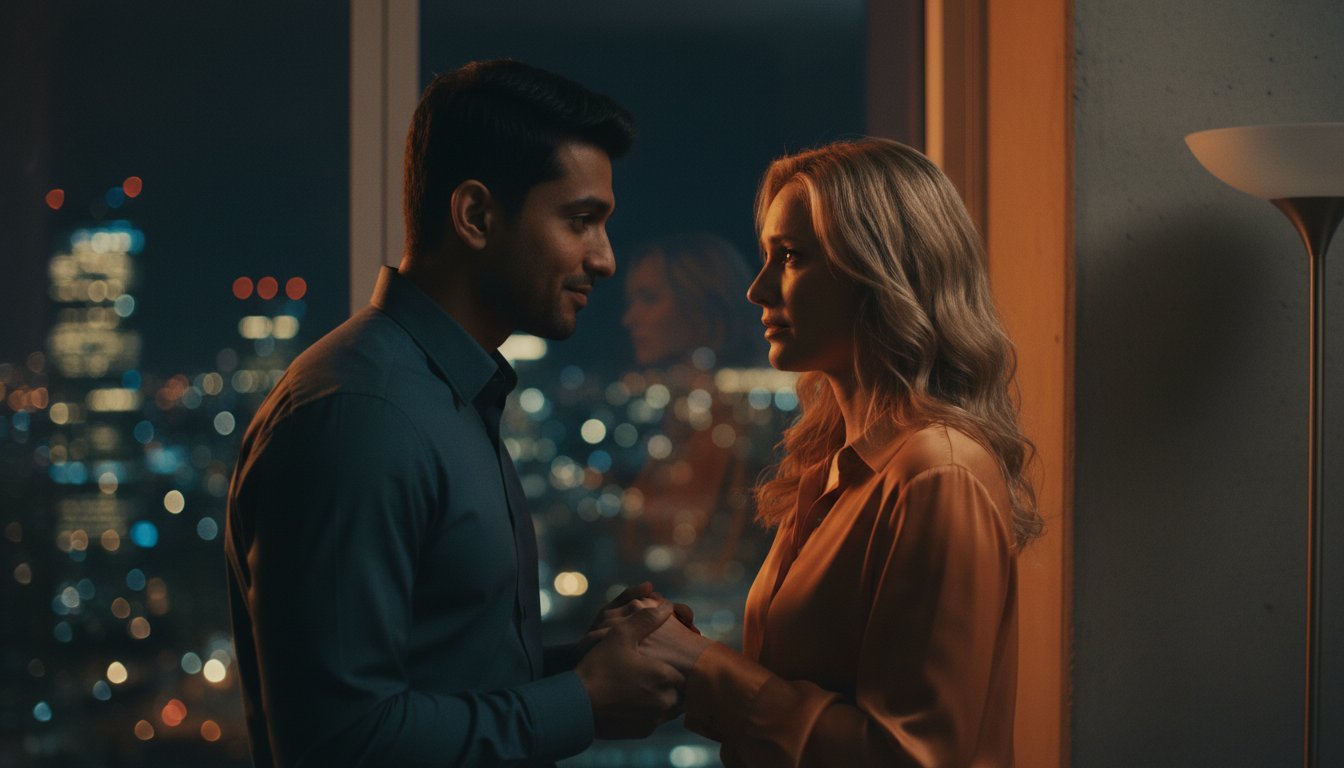
The mid shot is the ultimate stage for framing two characters, transforming a simple frame into a visual drama. The Two Shot is a dance. How close are they? Who holds the dominant space? Their proximity, posture, and eyeline within the frame define their entire relationship-harmony, conflict, intimacy, or distance-without a single word of dialogue. This is the silent symphony of human connection, and a vital tool in your mid shot film arsenal.
The Director’s Choice: When to Wield the Mid Shot
Forget the idea of a “default” shot. In the realm of high-stakes filmmaking, there are no defaults-only deliberate choices. The mid shot is not a lazy compromise between a wide and a close-up; it is a weapon you must learn to wield with precision. Your choice of frame is a direct manipulation of the audience’s perception and emotion. You are the conductor, and every shot is a note in your symphony.
To Reveal Subtext Through Body Language
This is where you transcend simple storytelling and begin to master the art of ‘show, don’t tell’. The mid shot is your canvas for contradiction. Use it when a character’s words are a lie, but their body screams the truth. It perfectly frames the trembling hands, the defensive posture, or the subtle clench of a jaw, giving the audience a privileged insight into the character’s soul that dialogue alone could never achieve.
To Control Pacing and Ground the Audience
A scene needs a heartbeat, a rhythm that guides the viewer’s experience. The mid shot is your anchor. After the grand scale of a wide shot establishes the world, cutting to a mid shot focuses the audience’s attention, pulling them closer to the human element without the shock of a sudden close-up. It creates a natural, breathable pace, preventing the visual whiplash that plagues amateur work and grounding the story in a tangible reality.
Mid Shot vs. Close-Up: Choosing Your Weapon
Think of it this way: the close-up is a scalpel, designed for the raw, visceral peak of an emotion. The mid shot is the spotlight that illuminates the path to that peak. You use the mid shot to build tension, to let a performance breathe, and to draw the audience in. Then, and only then, do you strike with the close-up. Overusing the close-up renders it powerless. A masterful mid shot film sequence preserves the sacred impact of that final, intimate frame.
Understanding this balance is the key to unlocking true cinematic control. It’s how you craft a unique audiovisual experience that feels intentional and powerful. This is the very foundation of the craft we explore at Cinemastery Academy, where you learn to make every single frame count.
Elevate Your Craft: Forging a Cinematic Mid Shot
You’ve mastered the definition. You understand its function. Now, we transcend the technical and enter the realm of art. A truly great mid shot is far more than a simple framing choice from the waist up; it is a symphony of meticulously crafted cinematic elements, each one playing in harmony to evoke a visceral response from the audience. This is where you stop being a camera operator and become a cinematographer.
To forge a shot that burns itself into memory, you must learn to wield the fundamental tools of visual storytelling with intent and passion. This is how you develop your signature.
Composition: The Geometry of Emotion
Forget thinking of composition as just a set of rules. Think of it as the invisible architecture of feeling. Placing a character on a rule-of-thirds intersection can create balance, while pushing them to the edge of the frame, surrounded by negative space, can scream isolation and vulnerability. Use leading lines not just to guide the eye, but to pull the audience deeper into the character’s world. A well-composed shot feels intentional, powerful, and emotionally resonant.
Lighting: Painting with Light and Shadow
Light is your paintbrush. It dictates the entire mood of your mid shot film frame before a single word is spoken. Do you want to convey honesty and optimism? Flood the scene with bright, high-key lighting. Or do you seek to explore internal conflict and hidden truths? Carve your subject out of the darkness with dramatic, low-key techniques like Rembrandt or split lighting. Lighting isn’t for visibility; it’s for revealing the soul of the story.
Lens Choice: Manipulating Perception
Your lens is not a piece of glass; it is the gatekeeper of perception. A mid shot captured on a wider 35mm lens feels immediate and grounded, connecting the character to their environment. Swap to a longer 85mm lens, and the world behind them compresses and melts away, isolating them and forcing an intense, intimate connection with the viewer. Your choice of focal length is a critical decision that directly manipulates how the audience feels the scene.
These are not rigid laws but powerful instruments awaiting a master’s touch. Combine them. Contrast them. Break them with purpose. The goal is to move beyond imitation and discover your unique visual voice. To dive deeper into the art of cinematic language, explore the path to mastery at Cinemastery Academy.
Beyond the Frame: The Soul of Your Story
The mid shot is not merely a technical choice; it is the sacred space where character and context collide. It’s the visual heartbeat of your narrative, revealing a soul’s internal struggle while grounding them firmly in their world. This delicate balance of intimacy and information is what separates the amateur from the auteur. Understanding the power of the mid shot film is a crucial first step, allowing you to craft scenes that feel undeniably real, emotionally potent, and visually unforgettable.
But this is just one tool. True mastery lies in conducting the entire visual symphony, turning chaos into harmony. Are you ready to move beyond imitation and find your authentic voice? At Cinemastery, you will learn the five core elements of filmmaking from award-winning instructor Nick Kioroglou-not as rigid rules, but as powerful instruments to forge your unique audiovisual signature. Unleash your cinematic voice. Master the language of film at Cinemastery.
The camera is waiting. Your story must be told.
Frequently Asked Questions About the Mid Shot
What is the difference between a mid shot and a medium close-up?
This is a battle of proximity and emotional access. The mid shot (waist up) gives your character room to breathe, to interact with their world through visceral body language. The medium close-up (chest up) pushes in, isolating the character’s upper body and face. It’s a more intimate invitation into their internal state, sacrificing environmental context for a deeper, more focused emotional connection. Your choice dictates what the audience is allowed to feel.
Why is the mid shot the most frequently used shot in narrative films?
The mid shot is the workhorse of cinematic storytelling because it strikes a perfect harmony between character and context. It’s the closest approximation to how we perceive people in real-life conversation, creating an instant, subconscious connection. This shot gives you enough space to capture revealing gestures and posture, yet remains intimate enough to register the subtle shifts in a character’s emotional state. It keeps the audience present and engaged without the jarring intensity of a constant close-up.
Can a mid shot also function as an establishing shot in a scene?
Absolutely. This is where you defy convention and manipulate reality. While a wide shot screams “location,” a carefully composed mid shot can establish a scene with intense focus. Imagine opening on a character at their desk; the frame reveals just enough of the cluttered office to establish their world as chaotic. You’re not just establishing a place, but a state of mind, immediately immersing the audience in the character’s personal space from the very first frame.
What is the best lens or focal length for capturing a powerful mid shot?
There is no single “best” lens-only the right tool for the emotion you must evoke. However, the masters often gravitate towards the 35mm to 50mm range. These focal lengths offer a naturalistic field of view that mirrors human perception, avoiding distortion or unnatural compression. This range allows you to capture a clean, honest mid shot film frame that feels authentic and deeply connected to the character’s reality, making it a transformative and reliable choice for powerful storytelling.
How do I frame a mid two shot to show the relationship between characters?
A mid two shot is a canvas for subtext. The space between your characters is everything. Are they framed closely, overlapping to suggest intimacy or a power struggle? Or is there a vast, empty space between them, screaming of emotional distance? Use their body language and eye-lines to sculpt the narrative. One character leaning in while the other recoils tells a more potent story than any line of dialogue ever could. You are crafting their unspoken truth.
Is the ‘cowboy shot’ only used in Westerns?
To confine the cowboy shot to Westerns is to cage a beast. Born from the practical need to frame a gunslinger’s holster, this shot (mid-thigh up) has evolved into a universal symbol of power and readiness. You’ll see it in action films as a hero prepares for battle or in a drama as a lawyer dominates a courtroom. Any time you must frame a character as a potent, grounded force, ready for action, the cowboy shot is your weapon of choice.