You’ve heard the whispers of its return-IMAX 70mm, Ultra Panavision-a language spoken by cinema’s most revered masters. Yet, the reverence is often shrouded in technical jargon, a wall of numbers that leaves many aspiring filmmakers asking the same fundamental question: what is the aspect ratio of 70 mm screen? To answer with a simple 2.20:1 is to offer a map without revealing the treasure. It’s a number, not an experience; a measurement, not the magic it unlocks. It ignores the soul, the visceral power, the very reason this format is considered the ultimate form of the art.
This is not an article about numbers. This is an exploration of the canvas itself. We will shatter the technical barriers and journey beyond the specifications to reveal the artistic intent behind them. You will demystify the formats, from classic widescreen to the breathtaking expanse of 2.76:1, and finally understand *why* visionary directors choose this legendary film stock to create a physical, immersive power that digital struggles to replicate. It’s time to stop seeing the frame and start feeling the world within it.
Key Takeaways
- Move beyond a simple number to understand how different 70mm formats-from classic widescreen to towering IMAX-create vastly different cinematic experiences.
- Discover the definitive answer to what is the aspect ratio of 70 mm screen by exploring the classic 2.20:1, the workhorse of Hollywood’s most revered epics.
- Uncover the secret behind the ultra-wide 2.76:1 frame and learn how anamorphic lenses transform the 70mm canvas into the ultimate epic spectacle.
- Grasp why visionary directors choose this legendary format, not just for its size, but for the unparalleled resolution, texture, and emotional weight it brings to the screen.
Table of Contents
- The Deceptive Simplicity: What is the REAL 70mm Aspect Ratio?
- The Classic Widescreen: Mastering the 2.20:1 Aspect Ratio
- The Ultimate Epic: Ultra Panavision 70 and the 2.76:1 Frame
- The Vertical Giant: IMAX 70mm and the 1.43:1 Aspect Ratio
- The Filmmaker’s Choice: Why the 70mm Canvas Endures
The Deceptive Simplicity: What is the REAL 70mm Aspect Ratio?
You’re chasing the ghost of cinema’s grandest epics, and you ask a simple question: what is the aspect ratio of 70 mm screen? The answer, like all great art, is a rebellion against simplicity. There isn’t just one. To truly understand this format is to understand that 70mm is not an aspect ratio-it is a canvas, a physical film gauge of breathtaking potential.
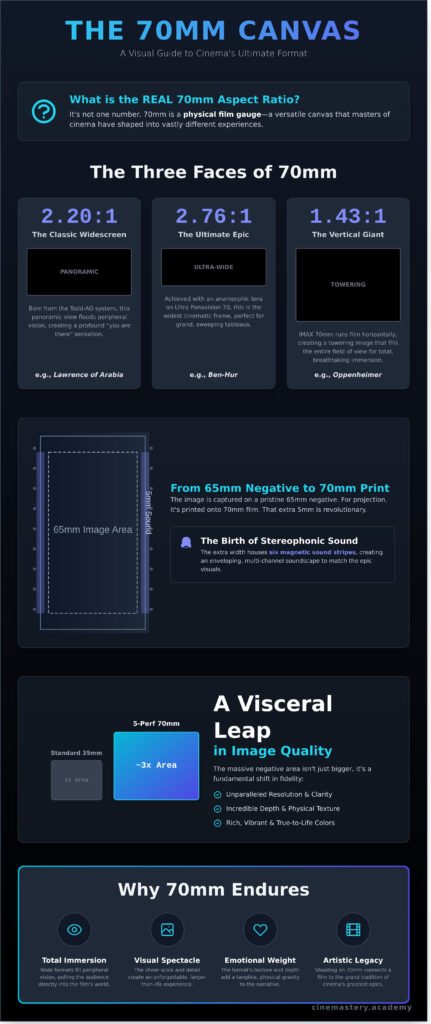
The most common aspect ratio you’ll encounter for a standard 70mm projection is 2.20:1. But this is merely the beginning of the story. The 70 mm film format is a versatile master, capable of bending reality into different shapes. Its primary variations are a testament to cinematic ambition:
- Standard 70mm (Todd-AO): The classic 2.20:1, offering a vast, panoramic view.
- Ultra Panavision 70 (Anamorphic): Uses an anamorphic squeeze to create a colossal 2.76:1 image, as seen in epics like Ben-Hur.
- IMAX 70mm (15-perf): A completely different beast, running the film horizontally to achieve the towering, immersive 1.43:1 ratio.
The secret lies in the negative. The image is captured on pristine 65mm film. For projection, it’s printed onto 70mm stock. That extra 5mm isn’t for the picture; it’s for something that transforms the entire experience.
The Anatomy of a 70mm Frame
Imagine a canvas with nearly three times the surface area of a standard 35mm frame. That is the promise of 70mm. The image quality isn’t just better; it’s a visceral leap into another reality. This is achieved through the ‘5-perf’ standard, where the camera pulls down five perforations of film for each frame, creating a larger, more stable, and incredibly detailed negative. It’s the difference between a sketch and a master’s oil painting-the resolution, clarity, and depth are simply on another plane.
Why the Extra 5mm Matters: The Birth of Stereophonic Sound
Remember that sound is 50% of your picture. The pioneers of 70mm understood this fundamental truth. Those extra 5mm of film stock were dedicated to housing six magnetic stripes for sound. This wasn’t just sound; it was the birth of the modern, multi-channel theatrical experience. This innovation allowed for a six-track stereophonic soundscape that could envelop the audience, turning a screening into a truly immersive event. The larger-than-life image was finally married to a sound with equal scale and majesty.
The Classic Widescreen: Mastering the 2.20:1 Aspect Ratio
In the cinematic arms race of the 1950s, as the flickering glow of television threatened to keep audiences at home, Hollywood unleashed its ultimate weapon: pure, unadulterated spectacle. The answer was not just bigger stories, but a bigger canvas. This gave birth to the majestic 2.20:1 aspect ratio, the soul of the 70mm epic. Born from the revolutionary Todd-AO system, this format was a declaration of war against the small screen, designed to be an overwhelming, theatrical experience that television could never hope to replicate. For filmmakers digging into the craft’s history, the question of what is the aspect ratio of 70 mm screen often leads directly to this iconic, panoramic frame.
Composing for the 2.20:1 Canvas
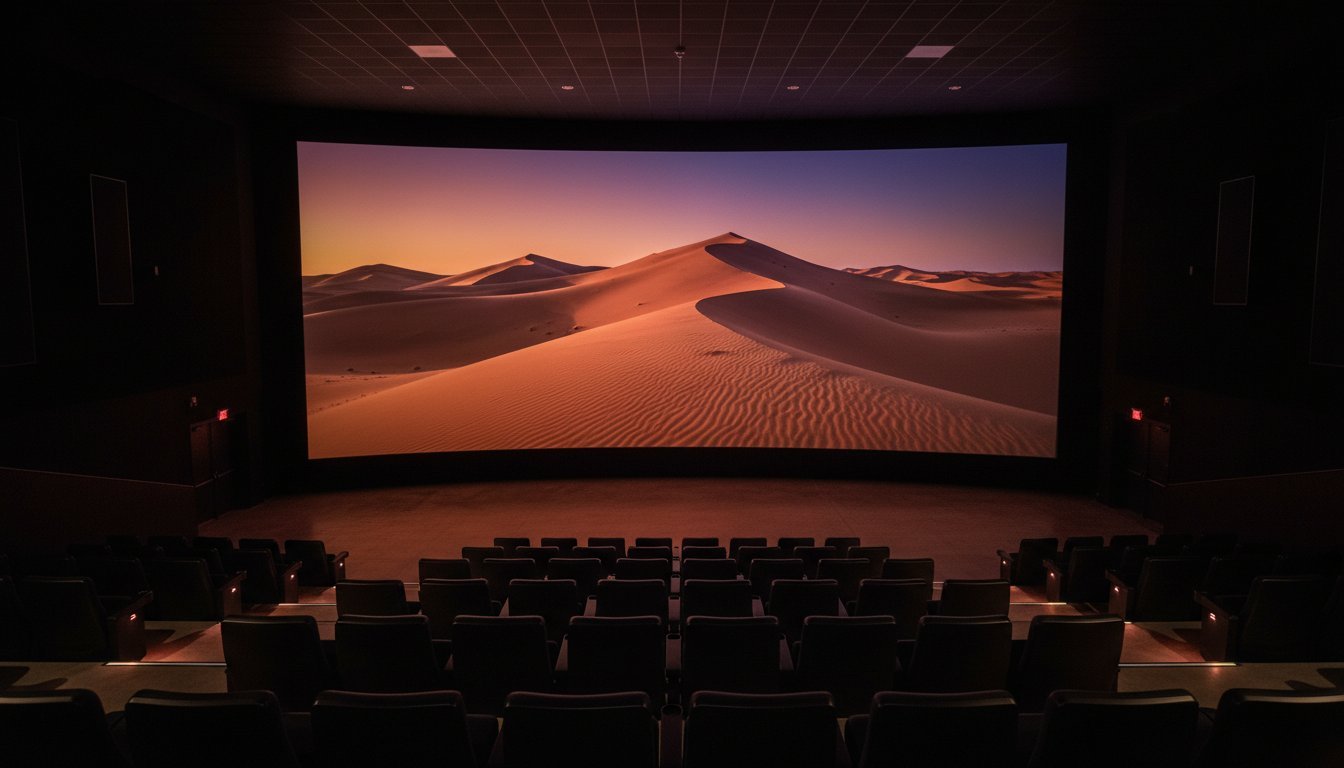
To shoot in 2.20:1 is to abandon the compositional safety of taller formats and embrace a new visual language. You are forced to think horizontally, to paint on a canvas that stretches to the very edges of human sight. It’s a format that rewards meticulous staging and deep focus, allowing you to orchestrate complex scenes with multiple points of interest. Masters like David Lean used this expansive frame not just to show landscapes, but to reveal character within them. In Lawrence of Arabia, the vastness of the desert is a living, breathing entity, swallowing actors whole to emphasize their profound isolation. Every frame becomes a grand tableau, a world unto itself.
The Immersive Experience for the Audience
The true power of 2.20:1 lies in its visceral, almost physical effect on the viewer. Unlike the standard theatrical 1.85:1, which can feel like looking through a window, 2.20:1 is a portal. It’s so wide that it floods your peripheral vision, dismantling the barrier between you and the screen and creating a profound “you are there” sensation. Think of the opening shots of The Sound of Music, where the camera glides over the Alps-the sheer width of the frame pulls you into the air alongside it. This is the very definition of immersion, a physical and emotional surrender to the world the filmmaker has built. While many formats exist, understanding what is the aspect ratio of 70 mm screen starts with appreciating this specific power to envelop the audience. It’s crucial, however, to distinguish this classic widescreen from the profoundly different, almost square IMAX 70mm 1.43:1 aspect ratio, which prioritizes overwhelming vertical immersion over horizontal grandeur.
The Ultimate Epic: Ultra Panavision 70 and the 2.76:1 Frame
If standard 70mm film is the grand canvas of cinema, then Ultra Panavision 70 is the Sistine Chapel ceiling. This is not merely a larger film stock; it is a declaration of visual ambition, a format designed to capture stories of monumental scale by fundamentally manipulating reality before it ever hits the celluloid. To achieve this, filmmakers turned to a piece of optical alchemy: the anamorphic lens.
Instead of just capturing a wide image, anamorphic lenses for 70mm film perform a breathtaking trick. They horizontally compress-or ‘squeeze’-an impossibly wide picture onto the 65mm camera negative. During projection, a corresponding lens reverses the process, de-squeezing the image onto the screen. So, while you might know the standard 70mm ratio, you may wonder, what is the aspect ratio of a 70 mm screen when this technique is used? The result is the breathtaking, all-encompassing 2.76:1 aspect ratio, one of the widest in cinematic history, used for epics like Ben-Hur (1959) to swallow the audience whole.
The Magic of the Anamorphic Squeeze
Anamorphic lenses are the gatekeepers of a distinct visual language. This optical compression and expansion isn’t perfect; it leaves behind beautiful, signature artifacts. The most famous are the streaking, horizontal lens flares and the distinct, elliptical bokeh (the out-of-focus parts of the image). These aren’t flaws; they are brushstrokes. They impart a painterly, dreamlike quality that screams cinema, a visceral texture that separates the art form from cold, digital perfection.
Storytelling on the Grandest Scale
A 2.76:1 frame is an awesome narrative tool. It’s a format that allows a director to orchestrate chaos with god-like control, filling the screen with the thundering chariots of Ben-Hur or the sprawling armies of The Battle of the Bulge. Yet, as a deep dive into The History of 70mm Film shows, its power isn’t just in scale. Quentin Tarantino revived the format for The Hateful Eight not for epic vistas, but to create a sense of intense, claustrophobic intimacy, trapping his characters together within the vast, lonely expanse of the frame. This is storytelling at its most commanding. It’s about owning the entire visual field.
Ready to master the frame? Explore the Cinemastery Cinematography course.
The Vertical Giant: IMAX 70mm and the 1.43:1 Aspect Ratio
Forget everything you think you know about 70mm film. When we discuss IMAX 70mm, we are not talking about a simple variation of widescreen; we are entering a different dimension of cinematic art. It is a format born from a desire to do more than just show a picture-it was engineered to overwhelm, to dominate your senses, and to create an experience so visceral it borders on reality. This is the ultimate canvas.
A Radical Shift in Perspective
The genius of IMAX lies in a fundamental, rebellious act: turning the film on its side. While traditional 35mm and 70mm film travels vertically through the camera and projector, IMAX 70mm film runs horizontally. This radical shift allows for a frame of unprecedented size. A standard 70mm frame uses 5 perforations (the sprocket holes on the side of the film). The IMAX frame uses a colossal 15 perforations. This creates a negative that is nearly nine times larger than standard 35mm, yielding a level of detail, color fidelity, and sheer clarity that digital formats still struggle to replicate. It is the purest image in cinema history.
The Power of the Tall Frame
This massive 15-perf frame produces a towering 1.43:1 aspect ratio. While widescreen formats like Cinemascope expand your horizontal view, IMAX expands your vertical world, filling your peripheral vision from floor to ceiling. It creates a feeling of immense height and scale, plunging you into the scene rather than letting you observe it from a distance. For a master filmmaker like Christopher Nolan, the question isn’t just what is the aspect ratio of 70 mm screen, but how that screen can be used to manipulate an audience’s perception of reality. In Dunkirk, it conveys the terrifying vulnerability of soldiers on an open beach. In Oppenheimer, it traps you in rooms with historical giants, making their world your own.
Widescreen shows you a landscape. IMAX 1.43:1 makes you stand in the middle of it. It’s not just a different shape; it’s a different language of filmmaking, a tool for those who dare to create truly unforgettable visual experiences. To wield such power is to achieve true cinematic mastery.
The Filmmaker’s Choice: Why the 70mm Canvas Endures
We’ve dissected the numbers and the technical specifications, but the true power of 70mm film transcends mere measurements. In an age where digital filmmaking risks a sterile homogeneity, choosing to shoot on 70mm is a declaration of intent. It is a commitment to an experience, a texture, and a scale that cannot be faked. This isn’t just about a bigger picture; it’s about a deeper, more visceral connection with the audience, turning a screening into a monumental event.
The choice is a rebellion against the clean, pixel-perfect image. It’s an embrace of a medium that lives and breathes, reminding the viewer that they are watching something crafted by human hands, not just rendered by a machine.
Texture, Grain, and the Soul of Celluloid
The subtle, organic grain of 70mm film is not an imperfection; it is the soul of the image. This is the tangible texture that separates cinema from digital video. While digital sensors strive for flawless clarity, film grain gives the image a physical presence, a depth that feels more real, more human. It’s the visual equivalent of the warmth and subtle crackle of vinyl-an authentic signature that digital struggles to replicate without feeling artificial.
The Director’s Vision Made Manifest
Ultimately, understanding what is the aspect ratio of 70 mm screen is about understanding the director’s artistic arsenal. Each variation is a different brush for a different masterpiece, chosen to evoke a specific psychological response. The format is a language, and the masters use it to manipulate reality and immerse you in their world.
- 2.20:1: The classic canvas for immersive, sweeping epics like Lawrence of Arabia, drawing the audience completely into a meticulously crafted world.
- 2.76:1: Used for overwhelming the senses with sheer scale and grandeur, as seen in Quentin Tarantino’s The Hateful Eight, making landscapes and characters feel monumental.
- 1.43:1: The IMAX format is a tool for total, visceral immersion. It shatters the frame, filling the viewer’s entire field of vision to create an unforgettable, almost physical experience.
These aren’t just technical rules to be memorized; they are the instruments of your craft. You are the first and most important member of any audience you can have. Don’t just learn the rules. Define your vision. Join Cinemastery Academy.
From Aspect Ratio to Auteur: Your Canvas Awaits
The 70mm film is not merely a format; it is a declaration of artistic intent. We began by asking a seemingly simple question: what is the aspect ratio of 70 mm screen? The answer, as we’ve discovered, is a glorious spectrum of creative choice, a testament to the filmmaker’s ultimate ambition. From the sweeping 2.20:1 vistas of classic epics to the breathtaking expanse of Ultra Panavision’s 2.76:1 and the god-like vertical immersion of 1.43:1 IMAX, this is not a technical choice. It is the selection of a canvas, the very foundation upon which a director builds a world and commands an audience’s soul.
Understanding the canvas is the first step. True mastery comes from knowing how to fill it with visceral emotion and unforgettable imagery that defines your signature style. It is time to move beyond theory and into pure artistry. Learn directly from an industry professional through a curriculum built on the five pillars of filmmaking-the very essence of cinematic language. We will guide you as you forge the skills to find your unique cinematic voice. The world is waiting for your vision. Master every frame. Start your journey at Cinemastery Academy.
Frequently Asked Questions About 70mm Film
Why is it called 70mm film if the camera negative is 65mm?
The alchemy of cinema lies in the details. The image itself is captured on a pristine 65mm negative. For projection, that image is printed onto a 70mm film strip. The extra 5mm is not empty space; it’s a canvas for the sound, traditionally holding the six magnetic tracks for a rich, stereophonic audio experience. This fusion of a larger image with superior sound is what elevates 70mm into a truly visceral, immersive art form.
What is the aspect ratio of standard 35mm film compared to 70mm?
While standard 35mm film typically projects in 1.85:1 or 2.39:1 (anamorphic), the grand canvas of 70mm offers a majestic 2.20:1 aspect ratio. This isn’t just a wider frame; it’s a statement. It provides a more expansive visual field, allowing for breathtaking compositions and an unparalleled sense of scale. It transforms a movie into a world you don’t just watch, but one you can almost step into, feeling the full weight of the director’s vision.
Is 70mm film resolution really better than 4K or 8K digital?
This is a battle between cold mathematics and artistic soul. Digital resolution is measured in finite pixels, but film resolution is organic, derived from the grain structure of the celluloid. A high-quality 70mm frame is estimated to hold an equivalent resolution of 12K to 18K. More importantly, film captures light with a texture, depth, and color richness that digital struggles to replicate. It’s not just about sharpness; it’s about the tangible feeling of a living, breathing image.
Can I experience these different 70mm aspect ratios at home?
You can experience a faithful representation, but not the true spectacle. A 4K UHD Blu-ray of a film like Lawrence of Arabia will present the movie in its correct 2.20:1 aspect ratio, using black bars (letterboxing) on your 16:9 screen. While this preserves the filmmaker’s intended composition and artistic integrity, it cannot replicate the overwhelming scale and immersive power of seeing that massive, light-infused image projected in a dedicated theater. The home version is a memory; the theater is the experience.
How many theaters in the world can still project true 70mm film?
The temples capable of this cinematic ritual are tragically few. As of recent counts, fewer than 150 theaters worldwide possess the specialized, meticulously maintained projectors required to screen true 70mm film. This scarcity makes each screening a pilgrimage for cinephiles-a rare opportunity to witness cinema in its most potent and magnificent form. It’s a testament to the dedication of those who fight to keep the magic of analog projection alive for a new generation.
What’s the difference between a 70mm ‘blow-up’ and a native 70mm film?
The difference is the very soul of the image. Native 70mm is shot on a 65mm camera negative, capturing immense detail at the source. A ‘blow-up’ is shot on standard 35mm and then optically enlarged onto a 70mm print. While a blow-up offers better stability and sound than a 35mm projection, it can never match the breathtaking clarity and fine grain of a native 70mm image. Knowing what is the aspect ratio of 70 mm screen is one thing; knowing its origin is everything.