A two-hour escape. A ninety-minute thrill. A lifetime of work condensed into a fleeting, visceral experience on screen. For the uninitiated, the filmmaking timeline can feel like an impenetrable mystery-a chaotic vortex of time and money that somehow, miraculously, results in art. You see the final cut, but the years of sweat, passion, and relentless problem-solving remain hidden in the shadows. This disconnect is where so many aspiring creators get lost. The question isn’t just a matter of logistics; asking how long does it take to film a movie is to ask how a raw idea is forged into reality.
We are about to pull back the curtain. In this complete breakdown, you will journey from the first spark of a concept through the grueling harmony of the shoot, to the final, transformative magic of the edit. You will understand the crucial factors that stretch or compress a production schedule and grasp the fundamental differences between a raw indie project and a sprawling blockbuster epic. Forget the confusion and the overwhelming complexity. It’s time to master the dimension of time itself.
Key Takeaways
- Discover why filmmaking is a three-act journey, and how the most crucial work is done in pre-production before a single frame is ever captured.
- Uncover the real factors that determine “how long does it take to film a movie,” from the controlled chaos of the set to the intense demands of the shooting schedule.
- Grasp the alchemy of post-production, where raw, disconnected footage is meticulously shaped into a cohesive and visceral cinematic experience.
- Learn how the timeline for a passion-fueled indie film differs dramatically from a colossal studio blockbuster, and what drives those differences.
Table of Contents
- The Three Acts of Creation: A Movie’s Lifecycle
- The Crucible of Creation: Inside Pre-Production
- Capturing Lightning: The Reality of Principal Photography
- Forging Harmony: The Magic of Post-Production
- Indie Passion vs. Blockbuster Scale: Two Different Clocks
The Three Acts of Creation: A Movie’s Lifecycle
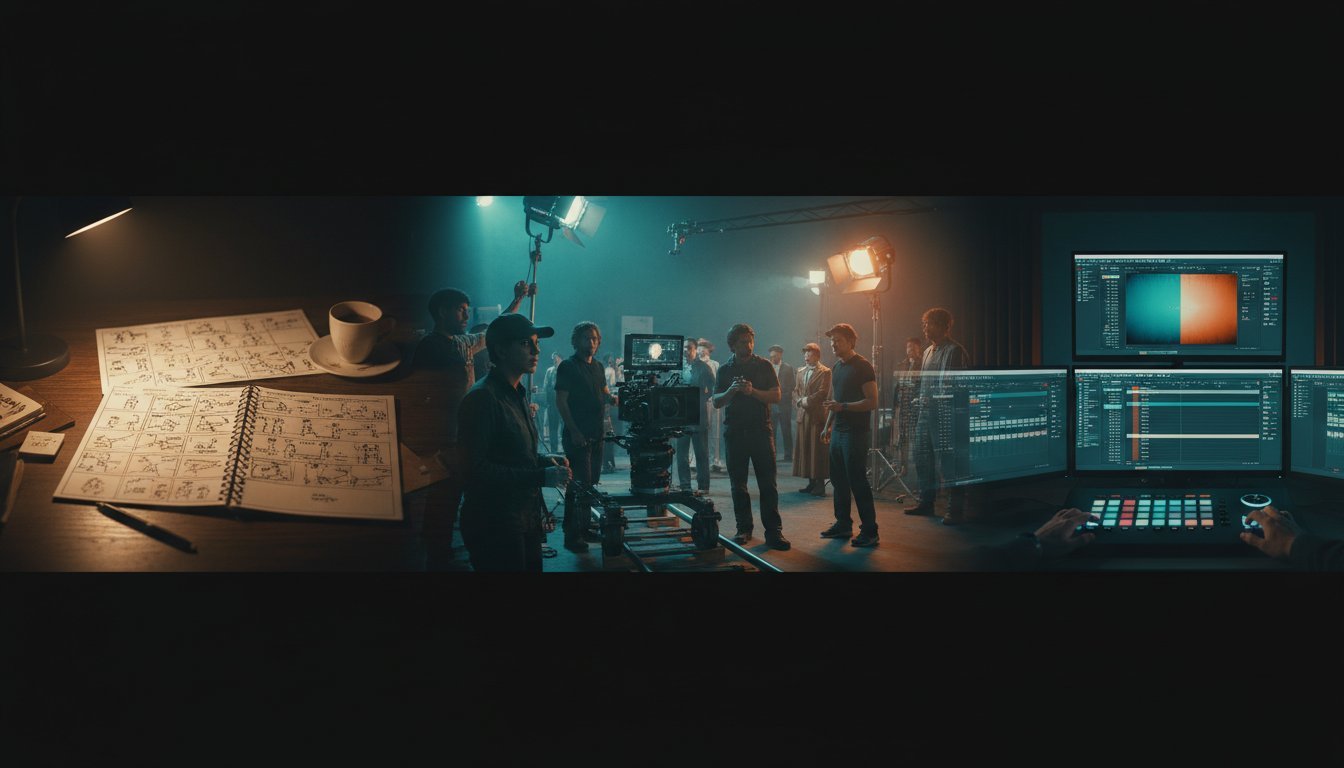
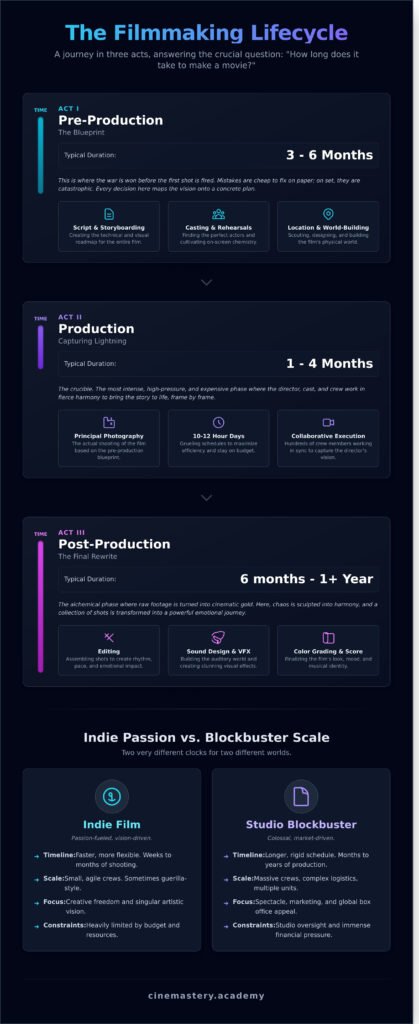
Filmmaking is not a single event; it is an epic, a transformative journey where an idea is forged into a visceral, emotional experience. To truly understand how long does it take to film a movie, you must first grasp its fundamental structure: a three-act lifecycle of creation. This entire process, often broken down into what Wikipedia calls The five stages of filmmaking, is a testament to the discipline required to manifest a vision. The total timeline can stretch from a single, intense year to a decade or more, depending on the scale of the dream.
Act I: Pre-Production (The Blueprint – 3 to 6 Months)
This is the sanctuary of preparation, the vital planning stage where the vision is meticulously mapped onto a blueprint for creation. Every decision here-from finalizing the script and casting the perfect actors to storyboarding every critical shot-is an act of intention. This is where the war is won before the first shot is ever fired. Mistakes are cheap to fix on paper; on set, they are catastrophic.
Act II: Production (Principal Photography – 1 to 4 Months)
Welcome to the fire. Production is the intense, fleeting, and most expensive phase of the entire journey. It’s the controlled chaos of the set, where the director, cast, and crew work in fierce harmony to capture the story frame by frame. Though often the shortest period, this is where the raw, untamed material of your cinematic dream is dragged into existence, second by precious second.
Act III: Post-Production (The Final Rewrite – 6 Months to 1+ Year)
This is the alchemical phase where raw footage is turned into cinematic gold. Post-production is where the true art of filmmaking reveals itself-where chaos is sculpted into harmony. Through the sacred arts of editing, sound design, visual effects (VFX), and color grading, the film finds its rhythm, its pace, and its soul. This is where the final, and most important, rewrite happens, and where a collection of shots is transformed into a powerful emotional journey.
The Crucible of Creation: Inside Pre-Production
Before a single frame is ever captured, before the lights are ignited or a director calls “action,” the film already exists. It exists as a meticulous, hard-fought blueprint forged in the crucible of pre-production. This is the unseen, alchemical phase where a director’s vision is translated from abstract dream to concrete reality. It’s an intense period of preparation designed to answer every possible question before it can derail the momentum of a shoot. The rigor of this stage is what separates a chaotic production from a symphony of creative efficiency.
Many aspiring filmmakers obsess over the question, how long does it take to film a movie, but they often overlook the months, or even years, spent in this foundational phase. A chaotic set is almost always the result of a rushed pre-production.
Script Lockdown and Storyboarding
Here, the screenplay transcends mere story and becomes a shooting script-a technical roadmap detailing every scene, action, and line. This document is then shattered into its core visual components through storyboards and shot lists. These are not just drawings; they are the film’s first breath, the visual guide that ensures the director, cinematographer, and crew all speak the same cinematic language when the pressure is on.
Casting, Rehearsals, and Chemistry
Finding the right actors is an art of summoning souls to inhabit characters. This can be a grueling process of months-long auditions and screen tests to find the perfect alchemy of talent and presence. But casting is only the beginning. Rehearsal is where the magic is truly cultivated-where actors forge visceral connections, explore the subtext, and discover the emotional heartbeat of their relationships long before they step onto the set.
Location Scouting and World-Building
Every story demands a world, and in pre-production, that world must be found or built from scratch. This is a monumental task of scouting physical locations, designing and constructing sets, securing permits, and managing complex logistics. This meticulous process, which can vary dramatically within an indie film production timeline compared to a studio blockbuster, ensures every backdrop and every prop serves the narrative, making the world of the film feel not just seen, but deeply felt.
Capturing Lightning: The Reality of Principal Photography
This is the crucible. When people ask, “how long does it take to film a movie?” they are almost always thinking of principal photography. This is the phase where the script is transmuted into raw footage, where theory becomes visceral reality. It is a high-pressure, intensely collaborative, and profoundly expensive process. Every day on set is a 10 to 12-hour marathon of precision and artistry, a relentless pursuit to capture not only every planned shot but also those unexpected, unscripted moments of lightning in a bottle.
The ‘Page-Per-Day’ Myth vs. Reality
In the film industry, you’ll often hear the shorthand of aiming to shoot between one and three pages of script per day. But this is a dangerous simplification. A two-page scene of intimate dialogue in a single room might be captured in a few hours. In stark contrast, a single paragraph describing a complex car chase could demand days of meticulous stunt work and dozens of camera setups to achieve just a few seconds of screen time.
The Tyranny of Logistics: Company Moves and Setups
The true battle on set is waged against the clock, dictated by the tyranny of logistics. Every new camera setup-a shift in angle, a change in lighting to sculpt an actor’s face-is a full reset that can consume hours. A “company move,” which involves relocating the entire cast, crew, and caravan of equipment to a new location, can burn half a day or more. These logistical hurdles are a major part of what determines how long each phase of movie production takes, turning a simple schedule into a complex puzzle.
The Human Element: Actors, Crew, and ‘The Perfect Take’
Filmmaking is a profoundly human art form. A director shoots multiple takes of a single line not because of error, but to mine for emotional gold-a flicker in the eye, a crack in the voice-that provides powerful options in the editing room. Coordinating the precise, synchronized movements of actors, camera operators, sound engineers, and gaffers is a logistical ballet. In this controlled chaos, the one perfect, soul-stirring take is born. Master the art of on-set direction at Cinemastery.
Forging Harmony: The Magic of Post-Production
The final “cut!” echoes across the set. The cameras are packed away, the lights are dismantled. But the film is not finished; in truth, its soul is just beginning to be forged. Post-production is the sacred space where the raw, visceral chaos of the shoot is meticulously sculpted into a coherent, emotional, and unforgettable story. Many filmmakers are surprised to learn that this phase can easily take two or three times longer than principal photography. When you ask how long does it take to film a movie, the unseen hours spent in darkened editing suites and sound mixing studios are a massive part of the answer.
The Editor’s Cut: Finding the Film’s Rhythm
Here, in the edit bay, the director and editor confront mountains of footage to find the hidden masterpiece within. They are sculptors, chipping away at stone to reveal the form. This journey moves through several crucial stages, from the sprawling assembly cut to the refined final cut, with each version honing the narrative, selecting the most powerful performances, and discovering the film’s unique heartbeat. This is where the story truly finds its voice and its pace.
Sound Design and Score: The Unseen 50% of the Film
Never forget this truth: sound is half of your picture. This is where the world of the film becomes truly immersive. Every layer-from the crispness of dialogue to the subtle hum of a city street and the thunderous impact of a sound effect-is intentionally woven together. The musical score is then composed and laid in, not as background noise, but as the emotional current that guides the audience’s heart through every scene. A masterful sound mix doesn’t just get heard; it gets felt.
VFX and Color Grading: Painting the Final Picture
The final alchemical process happens here. Visual effects (VFX) can range from erasing a stray microphone from a shot to creating entire photorealistic worlds from nothing. Following this, color grading gives the film its soul and mood. It’s not a simple filter; it’s a painter’s palette used to ensure visual consistency, evoke a specific tone-the cold blues of a thriller or the warm golds of a romance-and give the entire project that final, professional cinematic sheen. This is where a collection of images is transformed into cinema.
Indie Passion vs. Blockbuster Scale: Two Different Clocks
The question of how long does it take to film a movie cannot be answered with a single number. It’s a question of spirit and scale. The timeline for a director’s raw, first feature is a universe apart from a Marvel epic. One is a desperate sprint fueled by ingenuity; the other is a global marathon of immense complexity. Understanding this schism is essential to grasping the true nature of cinematic creation.
The Independent Film Timeline: A Crucible of Ingenuity
Here, constraints are the mother of invention. The indie timeline is forged in fire, where every second is paid for with sacrifice and passion. It’s a visceral, high-stakes game defined by its brutal efficiency.
- Development: Can stretch for years, a grueling quest for funding and belief.
- Pre-Production: Radically compressed into a few frantic weeks to conserve cash.
- Principal Photography: A feverish sprint, often just 15-30 days. Crews capture 5-10 pages of script per day, a pace that demands absolute commitment.
- Post-Production: A long, often lonely process where a small team, or even just the director, meticulously crafts chaos into harmony over many months.
The Studio Blockbuster Timeline: A Marathon of Complexity
This is filmmaking as a global operation. Once a studio greenlights a blockbuster, it becomes a well-oiled machine built to manage staggering complexity and deliver a world-class spectacle. Time is still money, but the scale is monumental.
- Development: Often moves quickly once a proven property or star is attached.
- Pre-Production: An extensive 6-12 month campaign of meticulous world-building, involving armies of concept artists, engineers, and designers.
- Principal Photography: A 4-6 month odyssey that can span multiple continents, coordinating thousands of cast and crew members.
- Post-Production: A massive, year-long industrial effort where hundreds of VFX artists, sound designers, and editors assemble the final vision, frame by digital frame.
Whether you command an army or a skeleton crew, the core principles of powerful storytelling-of creating a unique audiovisual experience-remain the same. Learn the skills to succeed at any level of production.
Beyond the Clock: Your Story Awaits
The journey from a fleeting idea to a final cut is not measured in mere days or months, but in dedication and vision. We’ve seen that filmmaking is a transformative odyssey through three distinct acts: meticulous pre-production, the intense crucible of principal photography, and the alchemy of post-production. Ultimately, the answer to how long does it take to film a movie is as unique as the story itself. It’s a testament to the passion required to turn chaos into harmony, whether on an indie passion project or a blockbuster scale.
Understanding the timeline is one thing; mastering the art is another. Your journey to mastering the art of filmmaking begins here. Explore the courses at Cinemastery Academy. You will master the five core elements of film: Narrative, Cinematography, Editing, and more. Learn from an instructor dedicated to helping you find your unique artistic voice and create something that defies the mundane. The world is waiting for your vision. It’s time to create it.
Frequently Asked Questions
Why does development and pre-production take so long?
Pre-production is where the soul of your film is forged. This phase isn’t about paperwork; it’s the sacred act of translating a vision into a tangible blueprint. Every choice-from the script’s rhythm to the color of a costume-is a deliberate stroke of the artist’s brush. Rushing this architectural process is like building a cathedral on sand. It takes time because you are not just planning a shoot; you are meticulously crafting the DNA of a new world.
How many hours a day do they film on a movie set?
A film set is a crucible where time bends to the will of creation. A standard shooting day is a brutal, exhilarating 10 to 12-hour marathon, often stretching even longer. This isn’t just the time the camera is rolling; it’s the entire ritual, from the first gear check at call time to the final wrap. This relentless pace is the price of admission for capturing lightning in a bottle, demanding a visceral commitment from every artist on set.
Can a movie be filmed in just a few weeks?
Absolutely. A film can be born in a flash of creative fire, shot in just a few weeks. This guerilla approach, seen in indie masterpieces, trades sprawling timelines for raw, concentrated energy. It demands an ironclad vision and a story stripped to its essential, beating heart. This isn’t a shortcut but a different path-a testament that the power of cinema is measured not in the length of the shoot, but in the depth of its impact.
How much footage is shot for a typical feature film?
Filmmakers are miners searching for diamonds of truth. For every minute you see on screen, there can be hours, even days, of raw footage. A shooting ratio of 20:1 is common, but it can easily climb to over 100:1. This means a 90-minute film might be carved from over 150 hours of captured reality. This isn’t waste; it’s the relentless exploration required to find those few perfect, visceral moments that define the final cut.
Does animation take longer to make than a live-action film?
Yes, animation is a fundamentally different beast. While a live-action shoot is a condensed storm of activity, animation is the patient, deliberate act of building a universe from nothing. Every single frame is an individual creation, a process that can stretch for years. One art form captures moments in time, while the other painstakingly constructs them. It’s the difference between bottling lightning and drawing it, stroke by meticulous stroke, across the cosmos.
How has technology changed the timeline for making a movie?
Technology is a double-edged sword. Digital cameras have liberated us from the limits of film stock, while non-linear editing has accelerated post-production. But this new freedom brings new complexities, like crafting intricate visual effects. So while some steps are faster, the question of how long does it take to film a movie is now more complex, as post-production can be an epic journey in its own right, demanding a new kind of digital mastery.