
THE CINEMASTERY JOURNAL
Best Mise-en-Scene Strategies for Low Budget Narrative Films
17 June 2026 · 15 min read
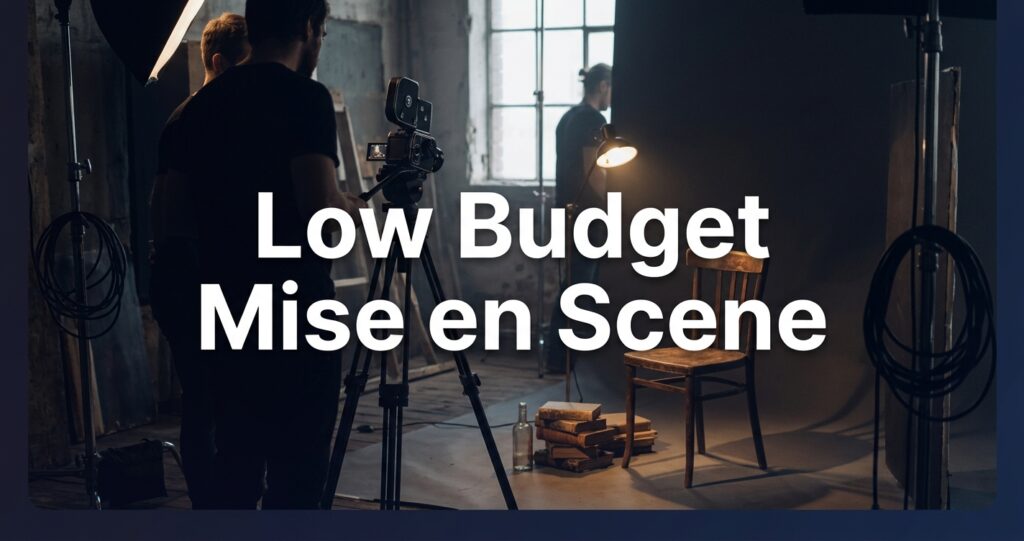
Mastering the best mise-en-scene strategies for low budget narrative films is one of the most powerful ways to make your production look far more expensive than it actually is. Remarkably, a large-scale analysis of over 13,000 video ads found that only 7% featured any human emotion on screen, which means simply staging believable, emotionally resonant performances in a carefully composed frame can do more for your film’s perceived production value than almost any piece of gear you could rent.
Table of Contents
- Key Takeaways
- Understanding Mise-en-Scene for Low Budget Narrative Films
- How to Maximize Existing Environments and Locations
- Strategic Use of Props to Build Story on a Budget
- Practical Lighting Strategies for Low Budget Narrative Films
- Costume and Character Design Without Breaking the Budget
- Blocking and Performance as Mise-en-Scene Tools
- Best Mise-en-Scene Strategies for Low Budget Narrative Films: Putting It All Together
- Conclusion
- Frequently Asked Questions
Key Takeaways
- Use what you already have: Existing locations, household props, and natural light are your most budget-friendly mise-en-scene assets.
- Staging beats set dressing: Thoughtful blocking and actor positioning communicate story just as effectively as expensive production design.
- Practical lights are story tools: Lamps, candles, and motivated light sources from within the scene create mood without a lighting package.
- Costume signals character instantly: A few deliberate wardrobe choices can define a character’s world, class, and arc with zero set construction.
- Continuity is achievable on a budget: Consistent blocking and stable visual anchors allow clean cuts even when shooting in uncontrolled environments.
- Props carry narrative weight: A single well-chosen prop placed deliberately in the frame can replace an entire page of exposition.
- Advancing your craft matters: Structured learning through resources like foundational filmmaking courses gives you the vocabulary to execute these strategies intentionally.
Understanding Mise-en-Scene for Low Budget Narrative Films
Mise-en-scene is the French term for “placing on stage,” and it covers everything visible in a film frame: set design, lighting, costume, props, and the positioning of actors. For low budget narrative films, understanding this concept is not just academic, it is a practical survival skill.
When you cannot afford elaborate sets, a large crew, or extensive post-production, mise-en-scene becomes your primary storytelling instrument. The goal is to make every visual choice intentional rather than accidental.
Unlike commercial productions that rely on production design budgets to signal world-building, independent and low-budget filmmakers must extract maximum meaning from minimum resources. That means every object, every light source, and every position in the frame has to earn its place.
If you are still building your foundational vocabulary, Level 1 filmmaking fundamentals can give you the grounding to apply these principles with confidence on set.
Five practical mise-en-scene strategies for low-budget narrative films. Learn how lighting, setting, props, and blocking can work together to strengthen storytelling without overspending.
How to Maximize Existing Environments and Locations
One of the best mise-en-scene strategies for low budget narrative films is treating every available location as a production design opportunity rather than a compromise. Real environments carry texture, history, and authenticity that no built set can replicate at a low price point.
The key is location scouting with a director’s eye, not just a production manager’s eye. You are looking for natural depth, interesting light sources, and surfaces that tell a story about who lives or works in that space.
How to Work a Location Strategically
- Identify the camera-friendly angles before you shoot. Walk the space and find the two or three framings where the background naturally layers (foreground, midground, background), because depth reads as production value on screen.
- Remove what breaks character. Clearing out contemporary signage, branded items, or anachronistic objects costs nothing but takes discipline. A clean, edited background reads as intentional design.
- Add one or two hero props to personalize the space. A single well-placed object (a framed photo, a particular book, a relevant tool) can anchor the scene in a character’s world without decorating the entire room.
- Use architecture to frame actors. Door frames, windows, arches, and stairwells are all built-in compositional tools. Position your actors relative to these architectural elements to create layered, visually complex frames at zero cost.
- Shoot in available light when the location is working for you. A location with strong directional window light already has a lighting direction, a mood, and a color temperature. Use it rather than fighting it.
The most resourceful filmmakers on low budgets treat location as the first act of production design, not the last resort.
Strategic Use of Props to Build Story on a Budget
In low budget narrative filmmaking, props are not decoration. They are compressed storytelling devices. A single prop used well can communicate backstory, character psychology, and thematic meaning in one cut.
The best mise-en-scene strategies for low budget narrative films treat props as a writing tool extended into the physical world. Before you decide what goes in a scene, ask what each object is communicating to the audience.
The Rules of Budget-Smart Prop Selection
- Choose props that do double duty. A character’s worn-out briefcase tells us about their financial stress. A prescription bottle on a nightstand tells us about their health, their daily routine, and possibly their state of mind. One object, multiple story layers.
- Source from thrift stores and personal collections first. The most lived-in, authentic-looking props usually come from actual use, not prop houses. Thrift stores are particularly reliable for period-adjacent or working-class settings.
- Keep the hero prop count low. Three meaningful props placed carefully beat twenty random objects scattered across a set. Restraint reads as confidence on screen.
- Plant props early for narrative payoff later. If a prop will matter in act three, it needs to be visible (even subtly) in act one. This kind of planted mise-en-scene requires no additional budget, only planning.
- Use props to define spatial relationships. A shared meal, a divided table, a prop passed between characters, all of these create physical grammar for your story’s emotional dynamics without a single line of dialogue.
Practical Lighting Strategies for Low Budget Narrative Films
Lighting is arguably the single most impactful element of mise-en-scene, and it is also the area where budget films most commonly underperform. The best mise-en-scene strategies for low budget narrative films approach lighting not as a technical problem but as a narrative one.
The question is not “how do we light this scene?” The question is “what does the light in this scene tell us about this moment?”
Practical Lights as Story Devices
Practical lights are light sources that are visible within the frame: desk lamps, overhead fixtures, candles, neon signs, television glow. They serve two purposes simultaneously: they provide actual illumination and they explain to the audience why the scene is lit the way it is.
- Use practicals to motivate your key light. Place a lamp just off-camera in the direction of the on-screen light source, and your key light becomes believable and grounded in the scene’s world.
- Modify practical bulbs with colored gels or smart bulbs. Changing the color temperature of a practical lamp costs almost nothing but shifts the emotional register of an entire scene.
- Embrace harsh shadows intentionally. A single hard light source creates dramatic, graphic shadows that read as stylistic choice rather than technical limitation, provided the composition supports it.
- Use daylight as a dynamic character. Scheduling scenes to capture golden hour, overcast diffusion, or the hard midday sun gives you free, unrepeatable light quality that no rental package can match.
Window Light Techniques
A large window is effectively a softbox. Positioning your actor near a window, using a cheap reflector or a piece of foam core to bounce fill, and controlling the ambient light in the room is enough to create clean, cinematic images on any camera.
This approach, combined with intentional blocking and camera placement, produces mise-en-scene that feels deliberately crafted rather than accidentally sufficient.
Costume and Character Design Without Breaking the Budget
Costume is the most personal layer of mise-en-scene. It is the character’s world worn on their body, and audiences read it immediately in ways they cannot always articulate.
For low budget narrative films, costume is one of the most cost-effective ways to add production value because it travels with your actors everywhere in the film. Every frame includes it automatically.
How to Build Meaningful Costume on a Small Budget
- Define each character’s palette before production. Assigning each character a color range (not a single color, but a family of tones) creates visual coherence across scenes and allows audiences to track characters intuitively.
- Use costume to show arc. A character who begins the film in tight, restrictive clothing and ends in looser, more comfortable clothes communicates internal change through mise-en-scene without requiring explicit dialogue about it.
- Shop thrift and vintage stores with the character in mind, not general aesthetics. Ask: what would this specific person wear, given their income, their vanity, their profession, and their era? That specificity is what makes costume feel real.
- Keep a continuity log from day one. On a low budget shoot, costume continuity errors are extremely common. A simple photo log of each actor’s costume on each shoot day costs nothing and saves enormous problems in the edit.
- Use costume to create visual contrast between characters. When two characters in a scene are dressed in clearly contrasting styles or color temperatures, their dynamic reads visually before they speak.
Blocking and Performance as Mise-en-Scene Tools
Blocking, the choreography of actors and camera within a space, is perhaps the most underused of all the best mise-en-scene strategies for low budget narrative films. It costs nothing. It requires only thought, rehearsal, and directorial intention.
When you cannot afford production design to tell your story visually, blocking must do more of the heavy lifting.
Blocking Principles for Low Budget Filmmakers
- Use proximity to show relationship. How close two characters stand to each other, and how that distance changes across a scene, is one of the most legible forms of physical storytelling.
- Use levels deliberately. A character who is consistently positioned higher in the frame than another communicates power, status, or control without a single line of exposition.
- Move the camera with character motivation. A camera move should feel motivated by what the character is doing or feeling, not by a desire to create visual interest for its own sake. Unmotivated camera movement in a low-budget context reads as technical overreach.
- Rehearse for blocking, then shoot. Even one structured rehearsal where actors walk through the scene’s physical choreography will save enormous time on the shoot day and produce more confident, natural performances.
- Use blocking to create natural coverage. If actors move through a scene in a deliberate arc, you can cover the scene with fewer set-ups, because the movement itself creates compositional variety.
For filmmakers moving from foundational technique into more complex directorial decisions, advanced filmmaking coursework can help you develop the specific language of blocking and staging as storytelling tools.
Best Mise-en-Scene Strategies for Low Budget Narrative Films: Putting It All Together
The most effective approach to mise-en-scene on a limited budget is systemic. Each element (location, props, lighting, costume, blocking) needs to work in concert rather than in isolation.
Here is a practical pre-production checklist for applying the best mise-en-scene strategies for low budget narrative films to every scene you write and plan:
Scene-Level Mise-en-Scene Checklist
- Location: What does this space say about the character who inhabits it? Have I removed anything that breaks the world of the story?
- Props: What is the single most important physical object in this scene? What does it communicate? Is it visible in the frame when it needs to be?
- Lighting: What is the light source within the world of the scene? Is my camera placement and key light consistent with that motivated source?
- Costume: Does each character’s costume for this specific scene reflect where they are in their arc? Does it contrast visually with the other characters in the scene?
- Blocking: Does the physical choreography of this scene express the emotional dynamics without relying entirely on dialogue?
- Camera: Does every camera position and move serve the story of the scene rather than the desire to create variety for its own sake?
Running through this checklist in pre-production, not on the day, is the single most efficient use of the limited preparation time most low budget productions have.
Where to Develop These Skills Further
Technical knowledge of mise-en-scene principles is only as useful as your ability to execute them under real production conditions. Structured training can significantly accelerate that gap between knowing a principle and applying it instinctively.
If you are building toward a more complete and intentional directorial practice, auteur-level filmmaking development focuses specifically on how personal visual language is built and sustained across a body of work, which is exactly the kind of long-term thinking that separates filmmakers who improve from those who repeat the same mistakes at scale.
For those who want a comprehensive package across all skill levels, the filmmaker bundle offers a structured progression from foundational principles through to advanced directorial craft.
Conclusion
The best mise-en-scene strategies for low budget narrative films all point toward the same principle: intentionality is more valuable than resources. A single motivated light source, a carefully chosen prop, a piece of blocking that externalizes a character’s emotional state, these decisions cost nothing but planning and craft.
What separates a low budget film that looks considered from one that looks merely cheap is not the size of the production design budget. It is whether the director made conscious choices about every visible element in the frame, and whether those choices serve the story.
Start with what you have. Build mise-en-scene habits into your pre-production process at the scene level. And invest in developing the craft knowledge to make those choices faster and more confidently with every project you complete.
Frequently Asked Questions
What is the most important mise-en-scene strategy for low budget narrative films?
The most important strategy is intentionality: every visible element in the frame should be a deliberate choice that serves the story. Among the best mise-en-scene strategies for low budget narrative films, using existing locations strategically and staging actors with purpose consistently produce the highest return for zero additional cost.
How do I make a low budget film look expensive using mise-en-scene?
Focus on depth in your compositions, motivated lighting, and removing anything from the frame that contradicts the world of your story. These three disciplines alone are among the best mise-en-scene strategies for low budget narrative films because they signal craft and intention rather than financial investment.
Can I use practical lights instead of renting a lighting kit for narrative filmmaking?
Yes, and in many cases practical lights produce more emotionally authentic results because they exist within the story world. Desk lamps, overhead fixtures, and candles all provide motivated light sources that support mise-en-scene by making the lighting feel grounded rather than imposed from outside the scene.
How do I use blocking as a mise-en-scene tool on a low budget shoot?
Plan your blocking in pre-production, not on the day. Use physical distance, levels, and movement to externalize the emotional dynamics between characters so that the staging itself tells part of the story. This is one of the most cost-free of all the best mise-en-scene strategies for low budget narrative films and one of the most consistently underused.
Is mise-en-scene more important than cinematography for low budget films in 2026?
They are interconnected, but mise-en-scene is arguably more foundational because it determines what is in front of the camera before any technical decisions are made. In 2026, with accessible cameras producing excellent image quality at low price points, the differentiating factor in most low budget narrative films is what is staged in the frame, not how it is captured.
How do props improve mise-en-scene without increasing the budget?
Props improve mise-en-scene by compressing story information into physical objects that the camera and actors can interact with. A single well-chosen prop can replace paragraphs of exposition, and sourcing from thrift stores or personal collections keeps costs negligible while often producing more authentic results than prop house rentals.
What courses can help me apply mise-en-scene strategies as a filmmaker?
Structured filmmaking education that progresses from foundational staging principles through to advanced directorial practice is the most efficient way to internalize mise-en-scene as an instinct rather than a checklist. Programs that cover the full production design thinking process, performance direction, and visual storytelling give you the vocabulary to execute the best mise-en-scene strategies for low budget narrative films on every project.