
THE CINEMASTERY JOURNAL
Intentional Contradiction Sound Design: Using Audio-Visual Dissonance in Film
17 June 2026 · 19 min read
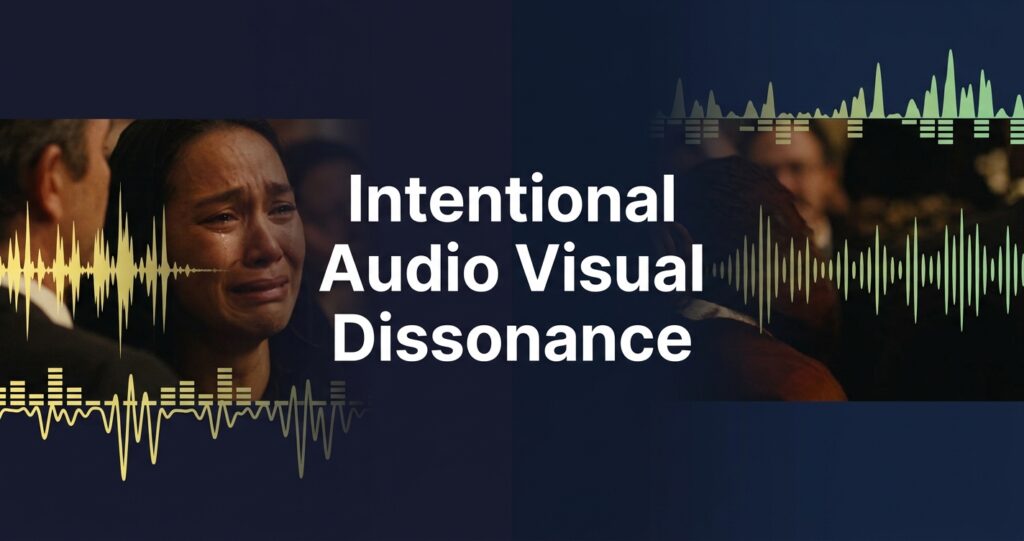
Intentional contradiction sound design, the deliberate practice of using audio-visual dissonance in film, is one of the most powerful and underused tools in a filmmaker’s kit. Research shows that music-incongruent conditions measurably alter emotional perception, with participants identifying happy faces correctly only 79% of the time under mismatched music compared to 87% under matched conditions, meaning the soundtrack you choose can literally change what your audience believes they are seeing.
Key Takeaways
- Audio-visual dissonance is intentional: Using the “wrong” music is a deliberate creative choice, not an accident, and can deepen narrative impact far beyond what matching sound achieves.
- The first 3 seconds matter most: Contradiction in the opening moments of a scene functions as an attention magnet, pulling viewers into a heightened state of alertness.
- Emotional counterpoint works differently than scoring to picture: Instead of reinforcing what the image shows, the audio pushes against it to create a third emotional meaning in the viewer’s mind.
- Lyrics carry narrative weight: Song lyrics in contradiction with on-screen action create irony, tragic undercutting, or dark humor depending on how they are deployed.
- Mood contradiction is a craft skill: Selecting wrong-feeling music requires understanding both the emotional logic of the scene and the tonal properties of the audio.
- Dissonance changes perceived emotional intensity: Incongruent music can inflate or suppress the emotion a viewer reads in a scene, giving you direct control over audience response.
- Workshop-style practice is the fastest path: Breaking scenes into discrete audio-visual units and testing multiple tracks against each is the most effective way to internalize this technique.
Table of Contents
What Is Intentional Contradiction Sound Design?
Intentional contradiction sound design is the practice of pairing audio, whether music, sound effects, or ambient texture, with visuals in ways that deliberately conflict with what the audience expects to hear.
Rather than scoring a scene to mirror its surface emotion (sad music under a funeral, tense music under a chase), this approach places audio against the grain of the image to generate a more complex or surprising emotional response.
The technique has roots in early cinema theory, particularly the concept of contrapuntal sound articulated by Eisenstein, Pudovkin, and Alexandrov, who argued that sound working against image would produce a richer, more productive meaning than simple synchronization.
In 2026, intentional audio-visual dissonance in film has moved from an avant-garde tool to a mainstream storytelling device used across drama, horror, comedy, and documentary.
Understanding the mechanics behind it allows you to apply it with control rather than relying on accident or intuition.
Capturing Attention in the First 3 Seconds with Audio-Visual Dissonance
The opening seconds of any scene set an emotional contract with the audience. When the audio breaks that contract immediately, the viewer’s attention spikes in a measurable way.
This is not an abstract claim. Research confirms that audio-visual conflict can rapidly capture attention away from task-relevant processing, functioning as an involuntary attentional pull that forces cognitive engagement with the contradiction.
In practical terms: if your image opens on something calm and the audio is wrong for it, the audience immediately asks “why?” That question keeps them watching.
Workshop Exercise: The 3-Second Contradiction Test
- Take any scene you are editing that currently opens with matching score or ambience.
- Mute the audio and write down the emotional word you would use to describe the image alone (e.g., “peaceful,” “menacing,” “joyful”).
- Open a music library and search for the opposite of that word.
- Drop that track under the first 3 seconds only and watch the scene. Note where your attention goes, whether it sharpens or dulls.
- If attention sharpens: you have a viable contradiction opening. If it dulls: the mismatch may be too abstract for that image.
The key distinction is between productive contradiction (the mismatch generates meaning) and chaotic mismatch (the mismatch generates confusion with no emotional payoff).
Productive contradiction works when there is a clear emotional logic to the conflict, one that the audience can eventually decode, even if they do not consciously understand it in the moment.
How to Select ‘Wrong’ Music That Makes Scenes Feel More Right
Selecting intentionally mismatched music is a craft decision, not a random one. The goal is to find audio that contradicts the surface emotion of the image while reinforcing a deeper or hidden emotional truth within the scene.
This requires you to read your scene on two levels simultaneously: what it appears to be and what it actually means.
Step 1: Identify the Scene’s Surface Emotion vs. Its Underlying Meaning
Write two columns. In the first, describe exactly what the images show and what a naive viewer would feel watching them with no sound.
In the second column, write what the scene actually means within the larger story, the subtext, the character’s internal state, or the thematic function of the sequence.
The gap between those two columns is where you find your contradiction cue.
Step 2: Map Emotional Opposites and Adjacent Emotions
Rather than simply picking the “opposite” of the surface emotion, work with emotional adjacency. For a scene that appears triumphant on the surface, the most powerful contradiction is often not pure sadness but something like wistful longing or hollow victory, emotions that sit near the surface feeling but undercut it.
Adjacent contradiction tends to feel more resonant than pure opposition because it gives the audience a recognizable emotional anchor while still generating surprise.
Step 3: Filter Candidates by Tempo, Key, and Texture
Even within a target emotional register, different musical properties create different dissonance effects:
- Tempo mismatch: Placing slow, meditative music under fast-cutting action creates a dreamlike unreality that can signal trauma, distortion, or the character’s dissociated state.
- Key mismatch: Major-key music under scenes of loss or violence creates a specific kind of horror or darkly comic effect used frequently in crime and war films.
- Texture mismatch: Delicate, intimate acoustic instrumentation under large-scale or violent imagery creates a sense of terrible intimacy, making the audience feel uncomfortably close to what they are watching.
Working through these filters systematically rather than relying purely on gut instinct is the difference between intentional contradiction sound design and accidental misalignment.
Filmmakers who study advanced craft at the level of authorial voice, such as those working through the Becoming an Auteur program, develop an intuitive library of these emotional mappings over time.
Emotional Counterpoint: The Core Technique of Audio-Visual Dissonance in Film
Emotional counterpoint is the structured application of intentional contradiction sound design. It borrows its name from musical counterpoint, where two melodic lines run independently but interact to create harmonic complexity.
In film, the two “voices” are the visual track and the audio track. When they run against each other with purpose, the viewer synthesizes a third emotional meaning that neither track would produce alone.
The Three-Layer Model of Emotional Counterpoint
Think of every scene as having three emotional layers:
- What the image says: The literal, visual emotional content (a character is smiling, the sun is shining, the scene is peaceful).
- What the audio says: The emotional content of the sound or music running against the image.
- What the audience feels: The synthesized response that emerges from the friction between layers one and two.
Your job in intentional contradiction sound design is to engineer layer three deliberately by controlling the interaction between layers one and two.
Workshop Exercise: The Three-Layer Mapping
Take a completed scene and fill in a three-column breakdown:
- Column 1: List the dominant visual emotion at each major cut or beat.
- Column 2: List the emotional quality of the music at that same moment.
- Column 3: Describe the synthesized feeling that results from the combination.
If column three contains only repetitions of column one or column two, there is no counterpoint, just doubling. The technique is working only when column three produces something new.
This level of analytical rigor over your own edit is part of what separates competent sound work from genuinely expressive cinema. Filmmakers building this kind of systematic craft often find the Advanced Filmmaking Level 2 curriculum a useful structural framework alongside hands-on practice.
Five techniques to create intentional audio-visual dissonance in cinema. The infographic illustrates how sound design can conflict with visuals to heighten mood and meaning.
Lyric-Based Narrative: Using Song Lyrics to Contradict or Deepen Meaning
Lyric-based contradiction is a specific and particularly potent form of audio-visual dissonance in film because lyrics carry denotative meaning, not just emotional mood.
When a song’s lyrics directly comment on, undercut, or ironize what is happening on screen, the audience processes the contradiction on a semantic level as well as an emotional one, which creates a much stronger, more memorable effect.
The Four Lyric Contradiction Modes
We identify four distinct ways that song lyrics can function in contradiction with the image:
- Direct irony: The lyrics describe the opposite of what is visually depicted. Joyful lyrics over a scene of destruction. This is the most legible form and risks feeling obvious if overused.
- Tragic undercutting: The lyrics describe something the character wishes for or will never have, while the image shows the reality of their situation. This mode is frequently used in character-study films to externalize inner life.
- Dark humor: Lyrics that are mundane, cheerful, or absurdly domestic run under scenes of violence or chaos, creating a tone that sits between horror and comedy. This is one of the signature devices of directors who use pop music in genre contexts.
- Prophetic contradiction: Lyrics that appear to have no relation to the current scene but which, in retrospect after later story revelations, take on a devastating meaning. This mode rewards attentive re-watching and builds long-term narrative resonance.
Workshop Exercise: The Lyric Audit
Pull the lyrics of any song you are considering for a scene and read them as a text independent of the music. Ask: if these words appeared as a subtitle or voice-over, what story would they tell?
Then compare that story to the visual story of the scene. The distance between them is your dissonance resource. The closer the lyric-as-text is to the scene-as-image, the less contradiction you have to work with.
This exercise consistently reveals surprising contradiction potential in songs that seem like obvious, matching choices at first listen.
Mood Contradiction Techniques: A Workshop Breakdown
Mood contradiction is the broadest category of intentional contradiction sound design, covering cases where the overall emotional atmosphere of the audio conflicts with the overall emotional atmosphere of the image without necessarily relying on specific lyrics or explicit emotional opposites.
These are the techniques most frequently available to sound designers and composers working within a film, and they are the foundation of professional audio-visual dissonance work.
Technique 1: The Wrong-Era Soundtrack
Placing music from a historical period that does not match the setting of the scene creates a temporal dissonance that immediately signals something is off. A period drama scored with contemporary electronic music is not anachronistic by accident but communicates a comment on the timelessness of the events being shown.
This technique works best when the era gap is large enough to be immediately perceptible and when the contemporary-sounding music carries emotional connotations that reinforce the scene’s subtext.
Technique 2: Genre Displacement
Scoring a domestic drama like a thriller, or scoring an action sequence like a lullaby, uses genre-coding as the contradiction mechanism. Audiences have deeply ingrained associations between musical genres and narrative contexts. Breaking those associations activates the same attentional mechanism that makes contradiction powerful in general.
Genre displacement is also useful for tonal control across a whole film. A horror film that refuses to score its frightening moments with horror-genre cues trains the audience into a state of perpetual unease because they can never predict when danger is coming.
Technique 3: Emotional Register Misalignment
This is the most precise form of mood contradiction: identifying the specific emotional register of a scene (intimate, bombastic, grief-stricken, ecstatic) and scoring it with music from a different register at the same tempo and approximate energy level.
Register misalignment is subtle enough to avoid feeling like a gimmick while still producing the dissonant, third-meaning effect that defines intentional audio-visual contradiction.
Technique 4: Diegetic-to-Non-Diegetic Contradiction
In this technique, the sound that appears to come from inside the scene world (a character’s radio, a TV playing in the background) contradicts the emotional reality of what the character is experiencing. Because the audience attributes diegetic sound to the scene’s world rather than to an authorial voice, the contradiction feels more like the universe mocking the character than like a directorial comment, which can produce a particularly painful or blackly comic effect.
Technique 5: The Absent Score
Removing music entirely from a scene that narratively demands it is itself a form of intentional contradiction. The audience’s expectation of a score becomes the “voice” that is being contradicted by silence. Used at moments of climactic emotion, the absent score can create a more overwhelming emotional effect than any music would achieve.
Intentional Contradiction Sound Design in Practice: Scene-by-Scene Analysis
Moving from theory to practice requires a systematic approach to every scene in your film. We recommend working through a scene-by-scene audio-visual dissonance audit during the assembly edit stage, before any final scoring decisions are locked.
The Scene Audit Process
- Watch each scene with no audio. Write down the raw emotional content of the images alone.
- Watch each scene with only the production sound (dialogue and room tone). Note how the natural audio already creates any unintentional contradictions or reinforcements.
- Identify the scene’s narrative function. Is it advancing plot, revealing character, establishing theme, or providing emotional release? The function determines what kind of sound design serves it best.
- Test three audio options: one that matches the surface emotion, one that contradicts it directly, one that uses adjacent-emotion contradiction. Play each and note the response in your body as well as your analytical mind.
- Evaluate which version produces the most complex or narratively useful emotional response in column three of your three-layer model.
This process does not always lead to contradiction. Sometimes the matching score is the right choice. The point is to make that choice deliberately rather than by default.
Thinking about how visual tone and color mood function in parallel with your sound choices also sharpens the overall design consistency of each scene.
Common Mistakes to Avoid When Using Audio-Visual Dissonance in Film
Intentional contradiction sound design is a high-skill technique with specific failure modes. Understanding what goes wrong is as important as knowing what works.
Mistake 1: Using Contradiction Without Narrative Justification
A contradiction that serves no story function is just noise. Every instance of intentional audio-visual dissonance in film should be traceable to a specific narrative purpose: revealing character subtext, establishing thematic irony, building tension, or generating a particular emotional synthesis in the audience.
If you cannot articulate why the contradiction serves the story, it probably does not.
Mistake 2: Over-Contradicting the Entire Film
Contradiction works through contrast with expectation. If every scene in your film uses dissonant sound design, the effect normalizes and loses its power. You need sections of conventional, matching audio to establish the baseline against which contradiction registers as meaningful.
Mistake 3: Choosing the Obvious Opposite Rather Than the Precise Opposite
The most effective contradictions are specific, not generic. “Sad music under a happy image” is a category of technique. “A specific minor-key waltz with a slightly too-fast tempo under a scene of forced celebration” is a precise creative decision. The specificity is what generates resonance rather than mere cleverness.
Mistake 4: Ignoring the Transition
How you enter and exit a contradiction cue is as important as the contradiction itself. An abrupt cut to a wildly mismatched piece of music can read as error rather than intention. Building in transitions, whether through gradual tempo shifts, diegetic sound bridges, or deliberate silence before the contradiction, signals that the mismatch is purposeful.
Mistake 5: Neglecting the Mix
A technically weak mix can undermine even the most conceptually strong contradiction design. The balance between music, dialogue, and effects within a contradictory sound bed requires careful attention to ensure the audience can decode the emotional information from each layer without one overwhelming the others.
This is where the foundational craft work covered in The Basics Level 1 modules pays off in more advanced work: a strong technical grounding makes expressive choices more reliable and more controllable.
Conclusion
Intentional contradiction sound design, and the broader practice of using audio-visual dissonance in film, is one of the most analytically rigorous and emotionally powerful tools available to filmmakers in 2026.
From capturing attention in the first 3 seconds, to selecting wrong music that makes scenes feel more right, to the structured techniques of emotional counterpoint, lyric-based narrative, and mood contradiction, the discipline rewards systematic study and deliberate practice.
The core principle is this: when sound and image work against each other with purpose, the audience’s mind does not simply split the difference. It synthesizes a third meaning that is more complex, more memorable, and more emotionally true than either track alone could produce.
Use the workshop exercises in this guide to audit your own work scene by scene. Build your library of emotional mappings between audio and visual registers. Practice the three-layer model until reading a scene’s surface versus its subtext becomes second nature.
Intentional audio-visual dissonance in film is not a shortcut or a trick. It is a craft skill that, when developed with rigor and intention, defines the difference between competent filmmaking and genuinely expressive cinema. Explore the full range of courses at Cinemastery Academy to continue developing your authorial voice across every dimension of film craft.
Frequently Asked Questions
What is intentional contradiction sound design in film?
Intentional contradiction sound design is the deliberate use of audio, particularly music, that conflicts with the emotional content of the visuals to create a richer, more complex audience response. Rather than scoring a scene to match what the audience sees, the technique places sound against the grain of the image to produce a synthesized emotional meaning that neither element would generate alone. It is a core tool of audio-visual dissonance in film.
Why does using the wrong music sometimes make a film scene feel more powerful?
When music contradicts the surface emotion of a scene, it forces the audience to actively process the gap between what they see and what they hear, which produces a heightened state of engagement and often reveals a deeper emotional truth in the scene’s subtext. Research confirms that mismatched audio actually changes what viewers believe they are perceiving, meaning the contradiction is doing real cognitive and emotional work rather than simply being stylistically unusual.
What is emotional counterpoint in film sound design?
Emotional counterpoint is the structured technique of running an audio track with its own emotional logic against a visual track with a different emotional logic, so that the audience synthesizes a third, more complex emotional response from the friction between the two. It is the most precise and controllable form of intentional audio-visual dissonance in film, and it requires the sound designer or director to consciously engineer the interaction between layers rather than leaving it to chance.
How do I use song lyrics to create narrative contradiction in my film?
Read the lyrics of any candidate song as a plain text, independent of the music itself, and compare the story those words tell to the visual story of the scene. The gap between those two narratives is your contradiction resource, and it can be deployed as direct irony, tragic undercutting, dark humor, or prophetic foreshadowing depending on the degree and type of mismatch you create.
Is audio-visual dissonance in film a good technique for horror?
Audio-visual dissonance is exceptionally effective in horror because it prevents the audience from using conventional sound-genre cues to predict when danger is coming, maintaining a state of perpetual unease across the entire film. Scoring frightening moments with cheerful, domestic, or sweetly melodic music is a particularly powerful form of mood contradiction that creates horror through wrongness rather than through conventional intensity.
How do I capture attention in the first 3 seconds of a scene using sound design?
Place audio that conflicts with the visual content of the opening frame, whether through tempo, genre, emotional register, or lyric content, because research shows that audio-visual incongruence functions as an involuntary attentional capture mechanism that forces engagement. The key is ensuring the contradiction is perceptible enough to register immediately but purposeful enough to generate curiosity rather than confusion.
Is intentional contradiction sound design worth using in short films and low-budget productions in 2026?
Intentional audio-visual dissonance in film is one of the most cost-effective advanced techniques available because it requires creative decision-making rather than expensive resources, and it can dramatically increase the emotional sophistication of a scene without additional production costs. In 2026, with accessible music licensing platforms and flexible post-production tools, even micro-budget filmmakers can apply these workshop-level techniques to professional effect.