
THE CINEMASTERY JOURNAL
How to Write a Screenplay: The Blueprint of Powerful Story
24 February 2026 · 17 min read

The blank page stares back, a white void of infinite possibility and paralyzing fear. You have a vision-a visceral feeling, a character who won’t be silent-but the path to learning how to write a screenplay that truly lives feels shrouded in fog. Your characters feel like ghosts, your story wanders, and the rigid rules of formatting seem like a cage for your creativity. This is the barrier where so many powerful stories die before they have the chance to live.
But screenwriting is not a technical exercise; it is an act of alchemy. It is the art of transforming the chaos of imagination into the focused, visceral harmony of a story that breathes. In this guide, we move beyond the sterile mechanics and into the beating heart of cinematic narrative. You will learn to forge a core idea into an undeniable concept, build characters that bleed, and structure a story with the tension and release of a masterpiece. Prepare to conquer the blank page and type ‘FADE OUT’ on a script that demands to be seen.
Key Takeaways
- Discover why the soul of your story lies in its core truth, a vital element you must forge before ever typing a scene heading.
- Master the three-act structure not as a rigid formula, but as the essential architecture for building a visceral emotional journey.
- Learn how to write a screenplay where the plot is a direct consequence of unforgettable characters, driven by a desperate, undeniable want.
- Understand that the real art happens in the rewrite, where you transform the chaos of a first draft into a harmonious cinematic blueprint.
Table of Contents
- Before You Type a Word: Forging the Soul of Your Story
- The Architecture of Emotion: Mastering Screenplay Structure
- Breathing Life into the Page: Crafting Unforgettable Characters
- The Craft of the Scene: Formatting and Visual Storytelling
- The Final Rewrite: Turning Chaos into Harmony
Before You Type a Word: Forging the Soul of Your Story
Forget everything you think you know. A screenplay is not a document; it’s a blueprint for a miracle. It is a spell cast in ink, designed to manipulate light and sound into a visceral, emotional experience. Before you ever worry about the rigid rules of screenplay format or the structure of a scene, you must answer a single, brutal question: Why does this story need to exist? The true first step in learning how to write a screenplay is to forge its soul in the fire of your own conviction, long before your fingers ever touch a keyboard.
Finding Your ‘Fuck Yea’ Element
Every great film begins with an obsession. A core image you can’t shake, a question that haunts you, a character that walks into your mind and refuses to leave. This is your ‘Fuck Yea’ element-the undeniable, electrifying core that makes you need to tell this story. It’s the visceral gut feeling that screams, “This must be made!” Brainstorming isn’t about finding a “good idea”; it’s about excavating the one that sets you on fire. Remember: you are the first and most important audience. If it doesn’t ignite you, it will never ignite anyone else.
Defining Your Theme
Plot is what happens. Theme is what it’s all about. Theme is the resonant truth, the moral or philosophical argument that pulses beneath the surface of your narrative. It’s the invisible force that guides your protagonist’s choices and shapes the world they inhabit. Ask yourself: Is my story about the corrupting nature of power? The price of redemption? The idea that love cannot conquer all? Your theme is the soul of your film, and every scene, every line of dialogue, must serve it.
Mastering the Logline
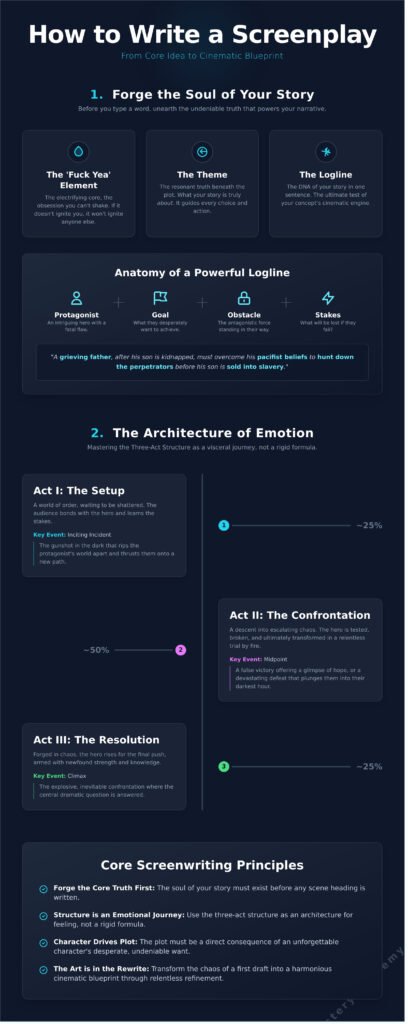
If your theme is the soul, the logline is the DNA. It is the ultimate test of your concept, distilled into a single, compelling sentence. A powerful logline proves your story has a cinematic engine before you write a single page. It must contain the essential components of conflict:
- The Protagonist: An intriguing hero with a fatal flaw.
- The Goal: What they desperately want to achieve.
- The Obstacle: The antagonistic force standing in their way.
- The Stakes: What will be lost if they fail?
Example: A grieving father (protagonist), after his son is kidnapped, must overcome his own pacifist beliefs (obstacle) to hunt down the perpetrators (goal) before his son is sold into slavery (stakes).
Write it. Rewrite it. Test it on people. If the logline doesn’t hook you, the story is broken. Fix it here, or you will fail on page ten.
The Architecture of Emotion: Mastering Screenplay Structure
Forget the formulas. Forget the rigid cages that suffocate creativity. Structure is not a prison; it is the skeleton that gives your story form, the sacred geometry that allows emotion to resonate with visceral power. It is the invisible architecture that guides the audience through chaos and catharsis. To understand how to write a screenplay is to understand that you are not merely telling a story-you are conducting an experience. You are manipulating time and tension to create a powerful emotional journey.
At the heart of this craft lies a timeless map of human experience. This ancient storytelling rhythm, often called the three-act structure, mirrors the universal pattern of order, chaos, and reordering. Each plot point you create is not just an event; it is a point of no return, a door slamming shut behind your protagonist, forcing them forward into the unknown. Pacing becomes your heartbeat, the rhythm of your film, controlling the sacred dance of tension and release.
Act I: The Setup – A World of Order
Here, you introduce your protagonist in their ordinary, flawed world-a carefully constructed reality waiting to be shattered. The inciting incident is the first tremor, the gunshot in the dark that rips their world apart and thrusts them onto a new path. This is where you forge the audience’s bond with the hero, establish the stakes that will haunt them, and pose the central dramatic question that will echo through every subsequent scene.
Act II: The Confrontation – A World of Chaos
Welcome to the crucible. Act II is a descent into escalating conflict where obstacles rise like monoliths, designed to break your hero. The rising action is a relentless trial by fire. This long, brutal journey culminates in the midpoint-a false victory that offers a fleeting glimpse of hope or a devastating defeat that plunges them into their darkest hour. Here, your character is tested, broken, and ultimately transformed.
Act III: The Resolution – A New Order
Forged in the chaos of Act II, your protagonist rises for the final push. Armed with newfound knowledge and strength, they face their ultimate test. The climax is the explosive, inevitable confrontation with the antagonistic force, where the central question is answered once and for all. What follows is the resolution: a quiet moment to breathe, to witness the fallout, and to establish the character’s new, irrevocably changed normal.
Breathing Life into the Page: Crafting Unforgettable Characters
Plot is the sequence of events. Character is the reason we care. This is the first and most sacred truth you must embrace on your journey. Before you write a single line of dialogue, you must understand that the machinery of your story-the car chases, the betrayals, the explosions-is meaningless without a human heart beating at its center. The transformative journey of a soul is the most powerful story you can ever tell. It’s the core principle behind how to write a screenplay that doesn’t just entertain, but endures.
The Want vs. The Need
Every unforgettable character is born from a fundamental schism. The Want is their conscious, external goal: to win the championship, to get the money, to save the world. It’s the engine driving the plot forward. But beneath this lies the Need-the unconscious, internal truth they must realize to become whole. This is their flaw, their blind spot. Your story’s true magic lies in forcing your hero on a journey where achieving their want is impossible without first confronting their need.
Building a Three-Dimensional World
A character is not a collection of traits; they are a living, breathing entity with a history that bleeds into their present. You must become a sculptor of souls. To do this, focus on three pillars:
- Voice: How do they speak? Their rhythm, vocabulary, and perspective must be uniquely theirs. Many of the best tips from Aaron Sorkin revolve around intention and obstacle, which are revealed through a character’s distinct voice.
- Backstory: What ghosts haunt them? What triumphs define them? Their past is the invisible architecture of their present-day decisions, informing every choice they make.
- Action: Don’t tell us they are brave; show them running into the fire. Character is revealed through choice and visceral action, not through lazy exposition.
The Antagonist: The Engine of Your Story
Your hero is a promise, but your antagonist is the force that makes them deliver on it. A weak villain creates a weak hero, a fatal flaw when you’re learning how to write a screenplay. Forget mustache-twirling evil; your antagonist must be the hero of their own story, pursuing a goal they believe is just with relentless conviction. This opposing force shouldn’t just create physical obstacles. They must be a philosophical counterweight, challenging your protagonist’s core beliefs and forcing them to evolve or break. They are the crucible in which your hero is forged.
The Craft of the Scene: Formatting and Visual Storytelling
A screenplay is not literature; it is a blueprint for an experience. It is the architectural plan for a cathedral of light and sound, where every line must serve the final, visceral impact on the audience. This is where you, the writer, become the first director, the first cinematographer, and the first editor. To master how to write a screenplay is to master the art of translation-transforming the intangible world of your story into a concrete guide for your collaborators.
The rules of formatting are not chains; they are a shared language. Learn them intimately so you can break them with intention and for maximum effect. Every word you commit to the page must earn its place by contributing to what can be seen or heard. This is the discipline of the craft: absolute economy, where less is always more.
The Essential Formatting Elements
Proper formatting ensures your story is read, not deciphered. It is the invisible framework that allows the soul of your film to shine through. These are the core components:
- Scene Headings (INT./EXT.): Your anchor. They instantly ground the reader in a specific location (Interior/Exterior) and time of day (DAY/NIGHT), establishing the world of the scene in just a few words.
- Action Lines: The domain of the senses. Written in the present tense, they describe only what the audience can see and hear. This is pure, objective storytelling-the raw data of the cinematic experience.
- Character and Dialogue: The voice of your film. The character’s name is centered, with their dialogue directly below. This is where you sculpt the rhythm, subtext, and unique soul of each person on screen.
- Parentheticals: A scalpel, not a sledgehammer. Used sparingly, these brief notes in parentheses can clarify a line’s specific intent or action (e.g., (sarcastically), (to herself)) when it isn’t otherwise obvious.
Writing Visually: ‘Show, Don’t Tell’
This is the cardinal rule, the very heart of cinematic language. You must exorcise internal thoughts and abstract emotions from your action lines, translating them into tangible, visible behavior. A character isn’t “sad”; she traces the rim of a cold coffee cup, her gaze lost somewhere across the room. Your action lines become a silent guide for the camera’s eye, focusing attention on a trembling hand or a revealing photograph without ever typing “CLOSE UP.” Every scene must be a battle, a seduction, a revelation. It must have a purpose, and it must turn the story.
Software and Tools of the Trade
While you can learn how to write a screenplay in any word processor, dedicated software like Final Draft (the industry standard) or free alternatives like Celtx handle the rigid formatting for you. The machine must serve the artist, not the other way around. The goal of any tool is to become invisible, freeing you to focus on what truly matters: the story, the characters, and the emotional journey. Ready to build your story? Explore our Narrative course.
The Final Rewrite: Turning Chaos into Harmony
Let this be known: the first draft is not writing; it is excavation. You have unearthed the raw, chaotic material of your story. Now, the true artistry begins. The secret of how to write a screenplay that feels alive, that delivers a visceral impact, is found not in the initial frantic typing, but in the patient, ruthless act of rewriting. This is where you manipulate the raw clay, where you carve away the excess to reveal the masterpiece within.
You must learn to kill your darlings. That perfectly crafted line of dialogue, that scene you adore-if it does not serve the narrative, it is a beautiful cancer. Cut it. The story’s heart must beat stronger than your ego. This is the uncompromising path of the storyteller.
The Rewriting Process
Rewriting is a layered, methodical assault on your own work. It’s not a single act, but a campaign fought on multiple fronts. We break it down into three essential passes:
- The ‘Vomit Draft’ Pass: First, get the story down. This is the raw, unfiltered expulsion of your idea onto the page. Do not judge. Do not edit. Just create the chaos.
- The Structural Pass: Now, you become the architect. Analyze the foundation. Does the pacing surge and recede? Are character arcs complete? Hunt down plot holes with a vengeance and seal them.
- The Polish Pass: Finally, you are the poet. Every word matters. Trim action lines to their muscular core. Make dialogue crackle with subtext. This is the final sharpening of the blade.
Seeking and Processing Feedback
A script is not forged in a vacuum. You need a war council-trusted readers who understand the sacred language of story. But feedback is a tool, not a command. Learn to listen for the problem behind the suggested solution. A reader might say “I don’t like this scene,” which is subjective. The objective problem might be that the scene lacks tension or fails to advance the plot. You are the ultimate guardian of your vision; filter every note through it.
Typing FADE OUT.
How do you know when it’s done? You feel it. The machine works. Every gear turns in perfect sync, every moment serves the whole. When you type those final two words, FADE OUT., it is more than an ending. It is the completion of a blueprint. You have crafted the soul of a film, a document from which a unique audiovisual experience can be born. The journey of learning how to write a screenplay is complete, but the path to mastery is just beginning. To learn what comes next, visit us at cinemastery.academy.
From Blueprint to Cinematic Fire
The screenplay is not mere text; it is the soul of a film captured on the page. We’ve journeyed from forging your story’s core truth to architecting its emotional structure and breathing life into unforgettable characters. Remember, the process of how to write a screenplay is a transformative act-a discipline of turning the chaos of an idea into the profound harmony of a finished draft. This blueprint is your testament, the foundation upon which cinematic worlds are built.
But the blueprint is only the beginning. To truly manipulate reality and create a unique audiovisual experience, you must master the language of cinema. Taught by an award-winning filmmaker, our Narrative course is where you will master the five core elements of cinematic art. It’s more than a class; it’s where you join a community of passionate, uncompromising storytellers dedicated to the craft. Your story is the blueprint. Learn to build the film. Explore the Narrative course at Cinemastery.
The world is waiting for your vision. Now, go create it.
Frequently Asked Questions About Writing Your Screenplay
Do I really need expensive screenwriting software to start?
Absolutely not. The art is in the story, not the tool. When you are learning how to write a screenplay, the focus must be on character, structure, and theme-the soul of the work. Start with free software or even a word processor with a template. The format is a sacred blueprint, but don’t let a price tag become an excuse. Your true investment is your courage to face the blank page.
How long should a feature film screenplay be?
The industry standard is a sacred covenant: one page equals roughly one minute of screen time. Aim for a lean, powerful script between 90 and 120 pages. Anything less feels underdeveloped; anything more suggests a lack of discipline. Your task is to manipulate time, to craft a two-hour journey that feels like a lifetime. Every page must earn its place in that visceral experience and serve the story’s momentum.
What is the difference between a spec script and a shooting script?
A spec script is a weapon, forged in solitude. It is your vision, pure and uncompromised, written “on speculation” to showcase your mastery of story and character. A shooting script is a battle plan. It’s a collaborative document, numbered, revised, and filled with technical details for the director, cast, and crew. One is the raw soul of the artist; the other is the meticulously engineered blueprint for production.
How do I write compelling dialogue that doesn’t sound like exposition?
Dialogue is not information; it is action. It is the sound of a character’s soul in conflict. Never have characters say what they mean directly. Instead, embed truth in subtext, reveal history through arguments, and show desire through what is left unsaid. Great dialogue is a weapon, a seduction, a confession-never a simple report. Let your characters fight, flirt, and bleed with their words.
Can I include camera angles and specific shots in my screenplay?
Tread with caution. You are the architect of the story, not the eye behind the camera. Your power lies in evoking a feeling, a moment, a visceral image through words. Only include a specific shot (e.g., CLOSE ON) when it is absolutely essential to the narrative-a reveal that can be shown no other way. Overuse usurps the director’s vision. Master the art of painting the scene with words, and trust your future collaborators.
How do I protect my script idea before I send it out?
An idea is ethereal, but a script is tangible proof of your labor. The moment you write it, it is copyrighted. For undeniable proof of creation, register your completed work with the U.S. Copyright Office or the WGA script registry. This creates a time-stamped record of your ownership. Do not let fear paralyze you. Protect your work, then have the courage to release it into the world where it belongs.
What’s the best way to handle writer’s block when I feel stuck?
Writer’s block is not a void; it is a signal. It means you have lost connection with the truth of your story or the soul of your character. Step away from the keyboard. Watch a film that ignites your passion. Listen to music that evokes the emotion of your scene. Live. The answers are not on the page. They are in the world, waiting for you to reclaim them. The art of how to write a screenplay is the art of living truthfully.