
THE CINEMASTERY JOURNAL
Film Cinematography: The Art of Painting with Light and Shadow
20 February 2026 · 14 min read
Is ‘cinematography’ just a buzzword you hear critics use, a vague concept that leaves your own work feeling flat and lifeless by comparison? Have you ever felt the visceral power of a scene-the creeping dread, the soaring triumph-and wondered what invisible force was shaping your emotions? That force is the soul of cinema. True film cinematography is not about the camera you own or the technical jargon you can recite. It is the silent, alchemical art of painting with light and shadow; it is the language that speaks directly to the subconscious, commanding feeling before the mind has a chance to think.
In this guide, we will shatter the illusion that this power is an inaccessible secret. We will move beyond sterile definitions and intimidating gear to uncover the core elements that give a film its pulse. You will learn how to read the visual story woven into your favorite films, understand what truly makes an image unforgettable, and gain the foundational knowledge to transform your own vision from a simple recording into a powerful, resonant experience.
Key Takeaways
- Understand cinematography not as a technical task, but as the art of forging a film’s soul and visceral emotional core.
- Discover how the inseparable trinity of camera, light, and composition must work in harmony to create a powerful and cohesive visual language.
- Learn to wield a film’s color palette as a powerful subconscious tool, painting emotions directly onto the screen to define its entire tone.
- Master the art of film cinematography by developing your creative vision first, transforming how you see the world long before you ever touch a camera.
Table of Contents
- What is Cinematography? Forging an Audiovisual Experience
- The Three Pillars of Cinematography: Camera, Light, and Composition
- Color Theory in Film: Crafting the Emotional Palette
- From Theory to Practice: How to Develop Your Cinematographic Eye
What is Cinematography? Forging an Audiovisual Experience
Forget the dictionary. Cinematography is not the sterile, technical act of recording action. It is the art of breathing life into a story, of painting with light and shadow to forge the very soul of a film. This is where we move beyond documentation and into the realm of creation. While a technical overview can explain the basics of what cinematography is, its true essence lies in its power to manipulate reality-to orchestrate a specific and profound emotional response in the audience.
This is the sacred line dividing the videographer from the cinematographer. A videographer captures an event. A cinematographer creates an experience. They are the high priests of visual storytelling, the ones who understand that how we see something is as important as what we see. At the helm of this visual alchemy is the Director of Photography (DP), the visionary tasked with translating a director’s abstract intent into a tangible, evocative visual language that will define the entire film.
The Language of the Lens
The camera is not a passive observer; it is the ultimate narrator. Every choice is a word in a visual sentence, a deliberate act of storytelling designed to translate a script’s cold text into a visceral feeling. The choice of a lens, the quality of light, the subtlety of a camera movement-these are the tools used to guide the audience’s eye, control their perception, and make them feel the terror, joy, or heartbreak of a moment. Masterful film cinematography is this absolute intentionality.
Cinematography vs. Mise-en-Scène
To grasp cinematography, you must understand its partner: mise-en-scène. Think of mise-en-scène as everything physically in the frame-the actors, sets, props, and costumes. It is the world. Cinematography, then, is how that world is captured and presented. It is the angle, the focus, and the light through which we witness the mise-en-scène. One cannot exist meaningfully without the other; together, in perfect harmony, they create a cohesive and potent audiovisual experience.
The Three Pillars of Cinematography: Camera, Light, and Composition
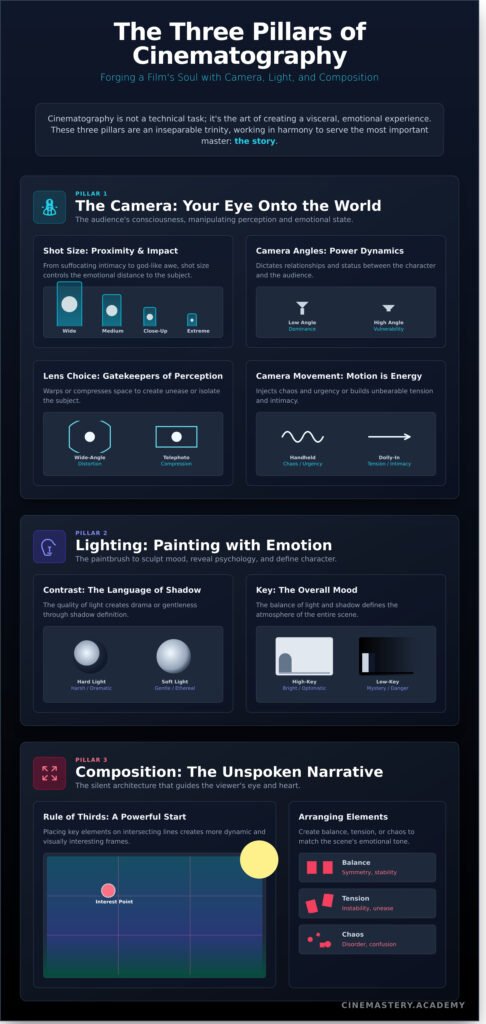
In the sacred art of film cinematography, every frame is built upon a trinity of power: the camera, the light, and the composition. These are not separate disciplines; they are a single, unified language spoken directly to the soul of the audience. They are inseparable, working in visceral harmony to create a cohesive look and feel. But remember this above all: these pillars exist to serve one master-the story. This foundational concept, often called The Three Pillars of Cinematography by leading film institutions, is the key to transforming a mere image into an unforgettable emotional experience.
Pillar 1: The Camera – Your Eye onto the World
The camera is not a recording device; it is the audience’s consciousness, the very portal through which they experience your world. Every choice you make manipulates their perception and emotional state. Master these fundamental tools:
- Shot Size: Control proximity and impact, from the suffocating intimacy of an extreme close-up that reveals a single tear to the god-like awe of an epic wide shot that dwarfs your characters in a vast landscape.
- Camera Angles: Dictate power dynamics. A low angle grants a character dominance and authority, while a high angle can make them appear vulnerable, trapped, or insignificant.
- Lens Choice: Lenses are the gatekeepers of perception. A wide-angle lens can create distortion and unease, while a long telephoto lens compresses space, isolating your subject from their world.
- Camera Movement: Motion is energy. A frantic, handheld camera injects chaos and urgency, while a slow, deliberate dolly-in can build unbearable tension or create a moment of profound intimacy.
Pillar 2: Lighting – Painting with Emotion
Forget visibility. Light is the paintbrush you use to sculpt mood, reveal psychology, and define character. While the classic three-point lighting setup is a vital foundation, true mastery in film cinematography comes from knowing when to break those rules to serve the narrative. Contrast is your language: hard light creates sharp, defined shadows that can feel harsh and dramatic, while soft, diffused light wraps around a subject, feeling gentle or ethereal. Use high-key lighting to create a bright, optimistic mood for comedy, or plunge your world into the deep shadows of low-key lighting to evoke the mystery and danger of noir.
Pillar 3: Composition – The Unspoken Narrative
Composition is the silent architecture of the frame, arranging every element to create balance, tension, or chaos. It is the unspoken narrative that guides the viewer’s eye and heart. While the Rule of Thirds is a powerful starting point for creating dynamic frames, it is only the beginning. Use strong leading lines to pull the audience deeper into the scene, create a sense of depth to make your world feel vast and real, and employ symmetry to convey order or unsettling perfection. Most importantly, understand the power of negative space-for what you don’t show is often more powerful than what you do, creating a void that the audience fills with their own fear and imagination.
Color Theory in Film: Crafting the Emotional Palette
Color is not decoration. It is the lifeblood of the image, a silent language spoken directly to the soul of your audience. In true film cinematography, every hue is a choice, every shade a deliberate brushstroke on the emotional canvas of your story. A film’s color palette doesn’t just set a mood; it builds a world, defines its rules, and reveals the hidden truths of its characters. It is one of the most powerful, subconscious tools you have to manipulate reality and create a unique audiovisual experience.
Your control over color begins long before you enter the editing suite. It’s born in the production design-the color of a character’s coat, the paint on a wall, the light filtering through a window. These physical choices provide the raw material. Post-production color grading is where you refine this material into a cohesive emotional statement. To truly master this interplay, you must Develop Your Cinematographic Eye for how light and color interact on set. A unified palette creates visual harmony, guiding the audience gently. Conversely, a clashing, discordant palette can create visceral tension, perfectly reflecting a character’s inner chaos.
The Psychology of Cinematic Color
Color speaks a universal psychological language. We instinctively feel the passion in a splash of crimson, the isolation in a wash of cold blue, or the optimism in a burst of vibrant yellow. A master filmmaker manipulates this language. Think of the sickly, digital green that defines the simulated reality in The Matrix, or the super-saturated reds and greens that paint Amélie’s world with overwhelming whimsy. You can drain the life from a character by desaturating their world, or amplify their mania with jarring, oversaturated hues.
Developing Your Film’s Color Grade
Color grading is the final, transformative act. It’s where you sculpt the light and shadow, pushing pixels to evoke a specific feeling and bake your film’s visual identity into the final image. Creating a custom Look-Up Table (LUT) ensures this identity remains consistent, unifying scenes shot days or miles apart into a single, immersive world. It’s the alchemical process that turns footage into cinema. Ready to wield this power? Master the art of color in our advanced editing course.
From Theory to Practice: How to Develop Your Cinematographic Eye
The greatest lie sold to aspiring filmmakers is that expensive gear creates powerful images. This is a fallacy. The camera is a dumb tool; it is your vision, your intent, that breathes life into the frame. True film cinematography is an act of seeing. It’s about learning to manipulate reality, to paint with light and shadow, and to guide an audience’s emotions before a single line of dialogue is spoken. This journey begins not in a store, but within your own mind.
Deconstructing the Masters
Stop consuming films; start dissecting them. Put on a scene from a master like Roger Deakins or Emmanuel Lubezki and mute the sound. Don’t ask what is happening, but why it is shown this way. Why that sliver of light? Why that suffocating close-up? Why does the camera float instead of staying still? The answers reveal the potent language of visual storytelling.
Practical Exercises for Aspiring DPs
Your phone is your dojo. Use it to forge your skills. Forget a grand production; focus on the fundamentals that separate the amateur from the artist.
- Three-Point Terror: Shoot a single object-a coffee cup, a book-with three radically different lighting setups. Make it feel heroic, then menacing, then lonely.
- Silent Story: Tell a complete story (a theft, a discovery, a heartbreak) in exactly five shots, with no dialogue. Every frame must carry the narrative weight.
- Still Life Composition: Spend a day only taking still photographs. Obsess over the rule of thirds, leading lines, and negative space until they become instinct.
Finding Your Signature Style
In an age where all films look the same, your style is your rebellion. It is not found by copying the latest trend. It emerges from the stories you are uniquely compelled to tell. Experiment relentlessly. Shoot things that feel wrong. Break the rules to understand why they exist. And above all, remember the core truth: you are the first and most important member of your audience. If an image doesn’t move you, it will never move anyone else.
The path from observer to creator is paved with intention and practice. The tools are secondary to the soul behind them. This is the heart of evocative film cinematography-transforming the mundane into the magical. Find your unique voice and forge your legacy with us.
Your Canvas Awaits: Master the Art of Cinematography
You now understand that the camera, light, and composition are not mere tools; they are the brushes you wield to paint your vision. You’ve seen how color theory isn’t just a technical chart but the very soul of your film’s emotional palette. This is the foundation of true film cinematography-the power to forge a visceral, unforgettable audiovisual experience that moves your audience beyond the screen and into the world you’ve created.
But theory alone is a silent canvas. To truly command the language of cinema, you must take this knowledge and forge it into mastery. Learn from an instructor dedicated to the pure art of film, master the five core elements of filmmaking, and finally develop the unique, signature style that separates you from the noise. Stop making videos. Start making cinema. Enroll in Cinemastery Academy. Your masterpiece is waiting to be filmed.
Frequently Asked Questions About Film Cinematography
What is the difference between a director and a cinematographer?
Think of it as a sacred partnership. The director is the keeper of the story’s soul, the visionary who guides the narrative and performance. The cinematographer is the master artist who translates that vision into a visceral, visual language. The director commands the “what” and “why” of the story, while the cinematographer wields light and shadow to control the “how” we experience it. It is a harmony of two artists forging one singular, transformative vision on screen.
Do I need an expensive camera for good film cinematography?
This is the great illusion that traps so many aspiring artists. Your camera is a tool, a simple brush. The real power resides in your eye, your soul, and your understanding of light. A master can create a masterpiece with the simplest of instruments, while a novice with an ARRI ALEXA will only produce polished emptiness. Do not chase gear; chase knowledge. True, evocative film cinematography is born from a mastery of craft, not a collection of expensive equipment.
What are the most common mistakes beginners make in cinematography?
The cardinal sin is worshipping technology over light. Beginners often fear shadow, chasing a flat, “clean” image that has no soul or depth. They move the camera without purpose, creating visual noise instead of motivated, emotional motion. They ignore the sacred rules of composition before they have earned the right to break them. They forget that their job is not merely to record reality, but to shape it into a powerful, unforgettable experience for the audience.
How do I start building a cinematography portfolio?
Your portfolio is not a resume; it is a declaration of your artistic soul. Do not wait for permission to create. Find a poem, a song, or a single powerful image and build a visual story around it. Collaborate with other hungry artists who share your passion. Shoot spec commercials or music videos that allow you to unleash your signature style. Your reel must be a testament to the unique vision only you possess, proving you can turn chaos into cinematic harmony.
Can cinematography be self-taught?
The path to mastery is always forged through obsession and self-discovery. You can absolutely teach yourself this craft, but it demands relentless dedication. Devour the work of the masters-not as a passive viewer, but as an apprentice dissecting every choice of light and lens. Then, you must shoot. Shoot constantly. Your camera and your mistakes will be your greatest teachers. True knowledge is burned into you through practice, failure, and the relentless pursuit of your vision.
What is the single most important element of cinematography to learn first?
Light. Before the camera, before the lens, before movement, there is only light. Light is the chisel you use to sculpt emotion, guide the eye, and build entire worlds from nothing. It is the language of the subconscious. To master cinematography is to master the art of painting with light and shadow. Every other technique is secondary to your command of this fundamental, almost mystical element. It is the very soul of cinema itself.